How AI-Driven Dispatch Reduces Haul Truck Idle Time and Improves Throughput
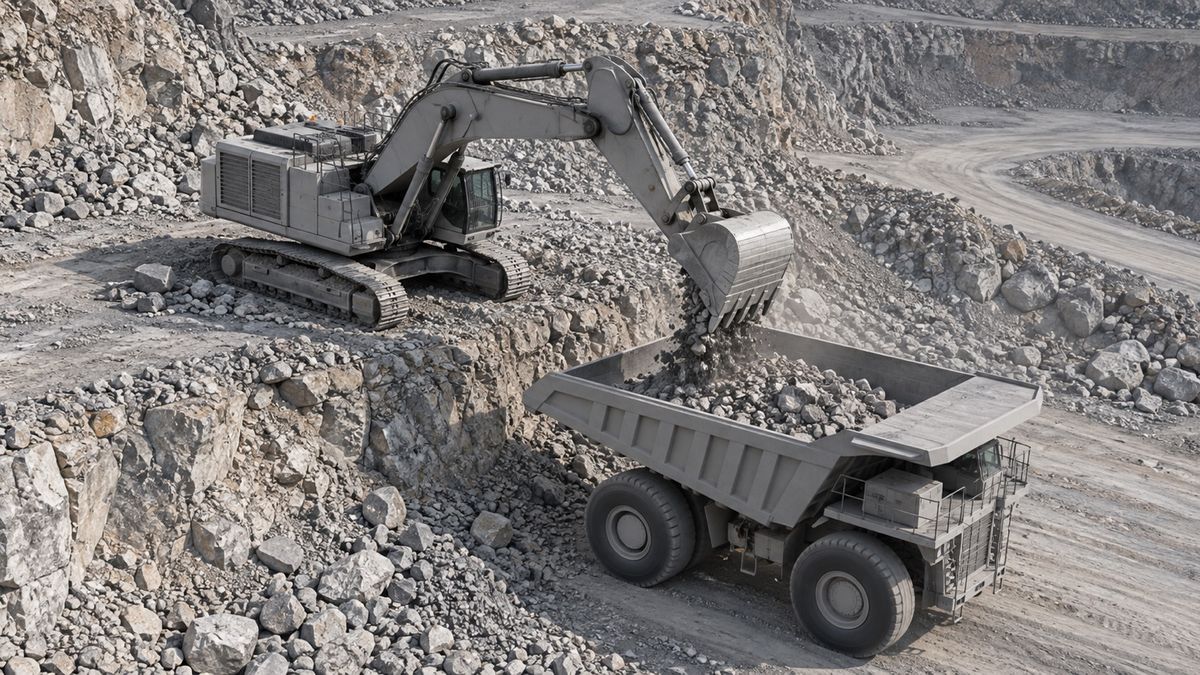
Haulage defines the economic structure of an open-pit mine.
Material movement accounts for 50% to 60% of total operating cost. Within that framework, haul truck idle time becomes one of the largest controllable value leakages in the system.
Large-scale operations routinely report trucks idle for 35% to 40% of available operating hours. That idle time compounds across fuel waste, asset wear, lost tonnage, and elevated emissions.
AI-driven dispatch in mining addresses this problem at its source by replacing reactive scheduling with predictive operational intelligence.
The True Cost of Idle Time
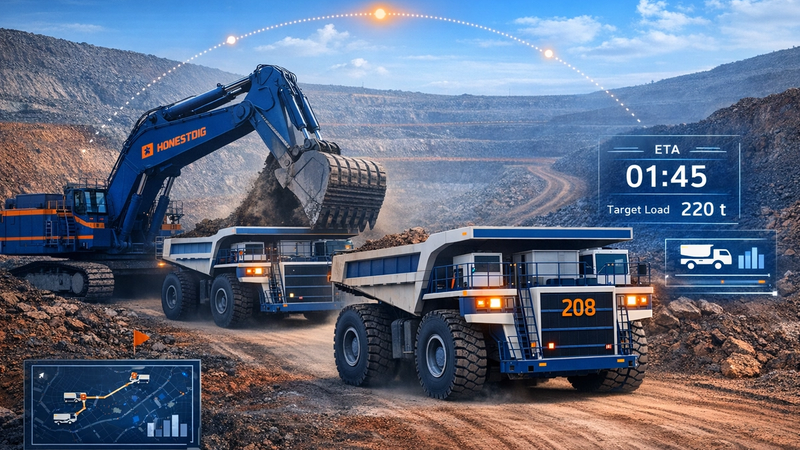
An ultra-class haul truck consumes between 300 and 500 liters of diesel per hour while hauling. Even when stationary, it burns fuel to maintain engine and system readiness.
Annual idle-related fuel waste per truck ranges from 100,000 to 150,000 liters. At average industrial diesel pricing, that translates to $120,000 to $180,000 per truck per year.
For a fleet of 50 trucks, idle fuel waste alone can exceed $9 million annually.
Idle hours also count toward engine service life. Excessive low-load operation can reduce Mean Time Between Overhauls by up to 25%. When rebuild intervals compress prematurely, fleets face several million dollars in avoidable capital expenditure.
Tire degradation adds another layer of loss. Uneven loading and unnecessary queueing reduce tire life by 20% to 30%, exposing large operations to multimillion-dollar replacement costs.
Lost production is the final multiplier. A reduction of 2,000 to 3,000 tonnes per day can materially alter annual profit outcomes depending on commodity pricing.
Idle time is not a marginal inefficiency. It is a structural profitability constraint embedded in haulage flow.
Why Traditional Dispatch Cannot Stabilize Throughput
Conventional dispatch systems were designed around deterministic models using Linear Programming or Mixed Integer Linear Programming.
They assume:
• Stable travel times• Predictable shovel loading rates• Constant crusher availability• Static road conditions
In practice, travel time fluctuates with congestion and rolling resistance. Loading rates shift with fragmentation variability. Crusher status changes unexpectedly. Weather alters ramp performance.
Rule-based dispatch assigns the next available truck according to priority rules. This often creates bunching at loading faces while starving others.
The system reacts after imbalance occurs rather than predicting it.
Reinforcement Learning and Adaptive Fleet Orchestration
AI-driven dispatch in mining introduces adaptive learning models that continuously evaluate the global state of the fleet.
Reinforcement Learning agents optimize dispatch decisions through ongoing interaction with real-time operational data. Instead of assigning trucks based on averages, the system evaluates:
• Predicted travel time• Real-time queue length• Shovel productivity rate• Grade deviation targets• Crusher status
Algorithms such as Proximal Policy Optimization allow the dispatch engine to learn uneven decision intervals inherent in mining operations. Decisions occur when trucks unload, shovels relocate, or bottlenecks emerge.
The objective shifts from reactive coordination to predictive flow stabilization.
Travel Time Prediction and Queue Prevention
Accurate haul truck travel time prediction is central to reducing idle time.
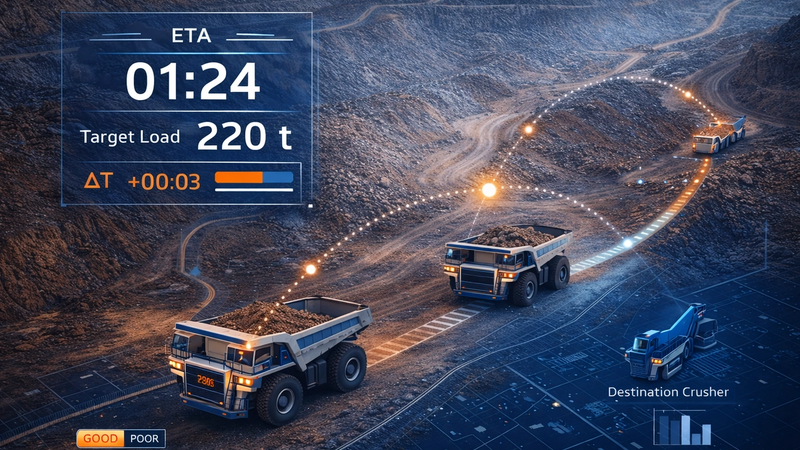
AI models incorporate:
• Route segmentation across elevation intervals
• Long Short-Term Memory networks for temporal traffic patterns
• Rolling resistance modeling
• Discrete-Event Simulation for road degradation forecasting
Reducing prediction error allows dispatch systems to align truck arrival precisely with shovel readiness.
This prevents queue buildup while maintaining consistent shovel utilization.
Dynamic cost functions continuously evaluate whether sending a truck to a given loading face will increase or reduce system-wide waiting time.
The result is fewer starved shovels and fewer congested crushers.
Eliminating Operational Blind Spots
Idle time is not only caused by mechanical failure. Significant delays originate from coordination gaps such as shift changes, refueling congestion, and material carryback.
AI-driven dispatch integrates these factors into routing logic.
Shift handovers can be synchronized with truck positioning and skill-aware operator allocation. Refueling can be scheduled within natural haul cycles instead of creating peak-hour congestion. Computer vision can detect bed retention and trigger clean-out tasks before payload efficiency degrades.
By embedding these adjustments into dispatch decisions, downtime windows are absorbed rather than amplified.
Integrating Predictive Maintenance into Dispatch
Throughput stability depends on equipment availability.
AI-driven systems ingest high-frequency engine and hydraulic telemetry to detect anomalies before failure. When risk thresholds are exceeded, dispatch logic can immediately adjust routing to reduce mechanical stress and prepare maintenance crews proactively.
Unplanned downtime for heavy industrial assets can exceed $100,000 per hour. Preventing cascading breakdowns through intelligent rerouting protects both tonnage and capital life.
This orchestration aligns with the broader framework of Real-Time Operational Intelligence in Mining, where fleet, maintenance, and production systems operate as a unified decision layer.
The HonestDig Intelligence Layer
AI-driven dispatch requires an intelligence layer capable of ingesting telemetry, modeling constraints, and triggering action in real time.
HonestDig’s AIM platform provides this orchestration capability by converting raw fleet data into predictive operational decisions.
For throughput-focused fleet synchronization, explore Guaranteed Production Throughput.
For workforce coordination during shift transitions and compliance control, review Autonomous Workforce Governance.
For integrated disruption management and environmental resilience, see Predictive Site Resilience.
Together, these modules convert dispatch from a scheduling function into a strategic control system.
Strategic Implications for Mining Leaders
Idle time is not inevitable. It is a coordination failure amplified by variability.
AI-driven dispatch stabilizes flow across loading, hauling, and dumping by predicting imbalance before queues form.
Throughput improves not by increasing fleet size but by increasing decision quality.
Fuel intensity declines.
Asset life extends.
Capital exposure reduces.
Emission intensity drops.
As ore grades decline and operational depth increases, haulage efficiency becomes the primary determinant of competitiveness.
Mines that implement predictive dispatch intelligence operate with structural advantage in cost, sustainability, and throughput stability.
The next step is architectural, not incremental.
If your operation is evaluating how to reduce haul truck idle time and stabilize throughput, explore how AIM by HonestDig enables real-time fleet orchestration and predictive dispatch at scale.
For deeper insight into throughput-focused optimization, review Guaranteed Production Throughput or connect with the HonestDig team to assess your current dispatch maturity.
Frequently Asked Questions
1. How much idle time reduction is realistic? Global benchmarks show reductions between 18% and 32% when AI-driven analytics and adaptive dispatch are implemented effectively.
2. Does AI-driven dispatch eliminate human oversight? No. It augments decision-making by providing predictive intelligence and automated response triggers.
3. Is ROI limited to fuel savings? No. The largest gains arise from stabilized throughput, reduced maintenance exposure, and avoided premature capital rebuilds.
4. Can this integrate with existing ERP or fleet systems? Yes. AI-driven dispatch functions as an intelligence layer above existing operational and enterprise systems.
5. Is this necessary before electrifying fleets? Yes. Battery-electric haulage requires advanced dispatch coordination to manage charging schedules and route optimization effectively.