Automating Workforce Governance and Safety Compliance in Mining
Explore how automation, AI, and digital systems improve workforce governance and safety compliance in mining with real-time monitoring and control.
Why Mining Operations Are Moving Toward Automated Governance
Mining has always been high-risk, but the way risk is managed is changing fast.
Aging workforce, rising labor costs, and stricter safety regulations are forcing operations to rethink how they manage people on-site. Traditional systems built on supervision, paperwork, and periodic inspections cannot keep up with the scale and complexity of modern mines.
The shift now is toward automation, where workforce governance and safety compliance are continuously monitored and controlled in real time.
This is not about replacing workers. It is about removing uncertainty from how work is performed.
What Workforce Governance Means Today
Workforce governance is no longer limited to attendance or basic compliance tracking.
It now includes:
- skill validation before task assignment
- role-based access to zones and equipment
- real-time monitoring of safety behavior
- fatigue and readiness tracking
- automated compliance documentation
Instead of multiple disconnected systems, these functions are becoming part of a single operational layer, similar to how real-time operational intelligence in mining connects production data.
From Manual Checks to Automated Control
The biggest difference between traditional and automated governance is consistency.
Aspect | Manual Systems | Automated Systems |
|---|---|---|
Validation | Depends on supervisors | Happens instantly |
Consistency | Varies across teams | Rules enforced uniformly |
Error Handling | Errors and delays are common | Risks identified before escalation |
Safety Response | Reactive | Proactive and preventive |
A simple example is workforce entry.
Instead of manually verifying documents, automated systems check certifications in real time. If a worker is not qualified, access is blocked immediately. This removes gaps that often lead to incidents.
How Automation Improves Safety Compliance
Automation changes safety from a periodic activity into a continuous system.
1. Real-Time PPE and Behavior Monitoring
AI-based vision systems monitor compliance across the site.
They detect:
- missing safety gear
- unsafe positioning near equipment
- entry into restricted zones
Alerts are triggered instantly, reducing dependency on manual supervision and preventing small violations from becoming major risks.
2. Skill Validation and Workforce Readiness
A major risk in mining is assigning tasks to workers who are not fully qualified.
Automated governance systems ensure:
- only certified workers are assigned critical tasks
- credentials are verified in real time
- access is linked to skill levels
This creates a workforce that is always compliant by design, not by inspection.
3. Fatigue Monitoring and Risk Prevention
Fatigue directly impacts reaction time and decision-making.
Modern systems use wearables and behavioral tracking to monitor:
- fatigue indicators
- physiological stress
- abnormal patterns in movement or response
Supervisors receive early warnings, allowing them to adjust shifts or reassign tasks before risk increases.
Technology Stack Behind Automated Governance
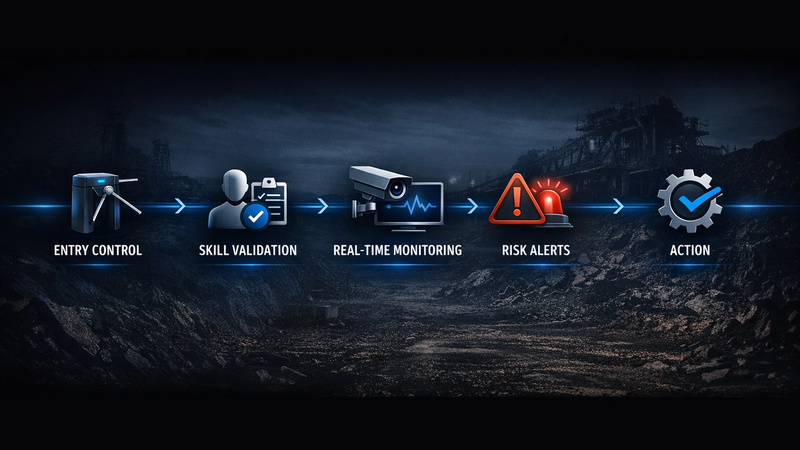
Automated workforce governance works because multiple technologies operate together as a connected system. It combines computer vision systems for safety monitoring, wearable devices for fatigue and health tracking, and access control systems for credential validation. These are supported by edge processing, which enables real-time decision-making, along with connectivity layers that ensure uninterrupted data flow across the site.
Together, these technologies ensure that data is not just collected but acted upon instantly, allowing operations to move from monitoring to real-time control.
This aligns with frameworks like predictive site resilience, where early detection drives faster response.
Where the Impact Becomes Visible
Mining operations adopting automated governance typically see measurable improvements across key areas. Safety performance improves as continuous monitoring helps identify risks early and reduce incidents. Compliance accuracy becomes more reliable, as automation removes manual errors in documentation and validation.
Operational continuity also improves, with fewer disruptions caused by safety incidents or compliance failures. At the same time, workforce efficiency increases through better allocation of skilled workers to critical tasks. Audit readiness is strengthened as well, with real-time records ensuring that compliance data is always available.
These improvements also support guaranteed production throughput by reducing unexpected downtime.
These improvements also support guaranteed production throughput by reducing unexpected downtime.
Why Many Implementations Fall Short
Even with strong technology, not all deployments succeed.
Common issues include:
- systems not integrated into daily workflows
- fragmented data across multiple platforms
- low workforce adoption
- focus on compliance reporting instead of operational use
Automation only delivers results when it becomes part of decision-making, not just monitoring.
From Monitoring Workers to Governing Work
There is a clear shift happening in mining operations.
Shift Area | Operational Impact |
|---|---|
Task Assignment | Based on skill validation |
Shift Planning | Based on fatigue data |
Site Access | Controlled through real-time compliance checks |
Safety Decisions | Driven by live risk indicators |
This is where workforce systems align with autonomous workforce governance.
What This Means for Mining Operations
Mining operations are moving toward systems where safety and productivity are connected.
Automating workforce governance allows companies to:
- reduce dependency on manual supervision
- ensure consistent compliance across the site
- respond faster to safety risks
- maintain stable production levels
For operations already investing in real-time operational intelligence in mining, workforce automation becomes a critical layer in building a fully connected environment.
It ensures that the right people are doing the right work, in the right conditions, at the right time.
Frequently Asked Questions
1. What is automated workforce governance in mining?
It is a system where workforce skills, safety compliance, and site access are managed using real-time data instead of manual checks.
2. How does automation improve safety compliance on mining sites?
Automation enables continuous monitoring through AI, sensors, and wearables, helping detect risks instantly instead of relying on periodic inspections.
3. Can automated systems prevent unqualified workers from accessing critical areas?
Yes. Role-based access control ensures only workers with valid certifications and skills can enter specific zones or operate equipment.
4. How is worker fatigue monitored using automation?
Wearables and AI systems track physiological and behavioral data to identify fatigue early and alert supervisors before it becomes a safety risk.
5. What is the biggest benefit of automating workforce governance?
It creates consistency. Safety rules and compliance checks are enforced in real time without depending on human intervention.