ERP Systems in Mining: Why They Cannot Optimize Modern Operations
ERP systems in mining manage compliance and finance, but cannot enable real-time operational intelligence. Learn why AI-driven intelligence layers deliver measurable gains in throughput, safety, and cost reduction.
ERP Systems in Mining: Why They Cannot Optimize Modern Operations
ERP systems in mining have long served as the backbone of enterprise administration. They unify finance, procurement, HR, and asset registers into a centralized system.
But modern mining operations are not administrative systems.
They are real-time, high-variability industrial ecosystems where milliseconds, geological uncertainty, and operational risk directly impact enterprise value.
ERP systems in mining are indispensable for compliance and reporting.They are not built to drive real-time operational intelligence.
The Stale Data Problem: When ERP Becomes Static
ERP platforms rely on batch processing and structured inputs. In volatile industrial environments, this creates delay.
Research in industrial operations shows that 63% of ERP production schedules fail to update when real-time changes occur on the floor, turning ERP into a static reference document rather than a dynamic control system.
In mining, where fleet dispatch, equipment health, and processing rates shift hourly, this latency introduces operational blind spots.
ERP tells you what happened.Optimization requires knowing what is happening and what will happen next.
The Financial Cost of Reactive Mining Operations
The economic stakes are significant.
According to research by McKinsey & Company, unplanned downtime and inefficient operations remain among the largest hidden cost drivers in heavy industry, with digital interventions delivering significant productivity gains.Unplanned downtime in asset-intensive industries can cost up to $500,000 per hour depending on scale and complexity.
In major mining operations, individual large repairs can exceed R1-million per day in lost productivity and parts.
ERP systems track these losses after they occur.
Mining operational intelligence prevents them by detecting anomalies before failure.
When IT OT convergence in mining is implemented effectively, organizations have reported:
- Up to 30% production efficiency improvements
- Predictive maintenance savings of 15% or more
- Coordinated fleet synchronization across dispatch, fuel, and asset health
These gains are documented across Industry 4.0 mining case studies and supported by McKinsey research on digital transformation in heavy industry.
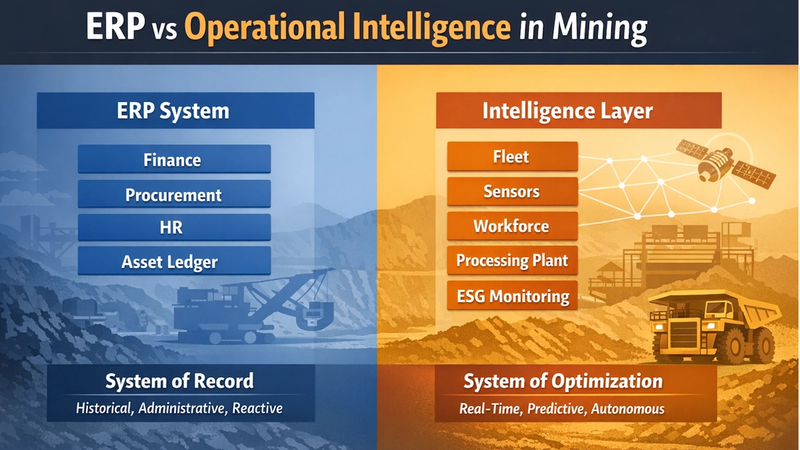
Platforms such as Guaranteed Production Throughput demonstrate how AI-driven synchronization of fleet dispatch, maintenance scheduling, and fuel logistics closes the intelligence-to-action gap.
ERP systems cannot perform that orchestration because they were never architected for real-time optimization.
Geological Uncertainty and the Net Present Value Risk
Mining is probabilistic. ERP systems treat ore as deterministic inventory.
Yet the financial implications of geological mismanagement are severe.
Industry financial modeling shows that 20% ore loss or 10% dilution can reduce a mining project's Net Present Value by up to 50%.
Because ERP systems in mining treat the orebody as fixed stock, they cannot dynamically integrate:
- Geostatistical simulations
- Conditional grade modeling
- Real-time drill telemetry
- Dynamic extraction adjustments
This creates silent revenue erosion.
Mining digital transformation must incorporate probabilistic modeling integrated with operational telemetry to protect long-term asset value.
Workforce Governance Requires Real-Time Enforcement
ERP HR modules manage payroll and attendance.
Modern mines require:
- Skill-aware task allocation
- Certification-controlled machine access
- Real-time zone geofencing
- Automated PPE compliance monitoring
AI agents using computer vision can detect missing helmets or respirators in milliseconds and reduce manual safety documentation processing time by up to 80%, according to industry safety automation deployments. Through Autonomous Workforce Governance, mines shift from reactive safety logging to proactive compliance enforcement.
This transition has contributed to:
- Up to 35% reduction in incident rates
- Improved labor allocation efficiency
- Reduced compliance risk exposure
ESG Performance Requires Continuous Operational Intelligence
Environmental performance is no longer quarterly reporting. It is continuous accountability.
ERP systems can store ESG financial records. They cannot monitor emissions, energy loads, and operational risk dynamically.
Studies by the International Energy Agency and industrial digital optimization programs indicate AI-driven load balancing and monitoring can reduce industrial energy use by up to 40%. With Predictive Site Resilience, mines integrate environmental monitoring, anomaly detection, and safety alerts into a unified command structure.
Operational excellence becomes measurable ESG performance.
ERP vs Intelligence Layer: Quantified Business Impact
Capability | ERP Systems in Mining | Integrated Intelligence Layer |
|---|---|---|
Data Processing | Batch | Real-Time Streaming |
Production Efficiency | Static Planning | Up to 30% Increase |
Safety | Reactive Reporting | 35% Incident Reduction |
Energy Optimization | Periodic Analysis | Up to 40% Reduction |
Maintenance | Reactive | Predictive |
Total Operating Cost | High Fixed Overhead | Up to 25% Reduction |
The Strategic Imperative for Mining Leaders
ERP systems in mining remain foundational.
But relying on ERP alone creates structural blind spots:
- Stale production schedules
- Reactive downtime exposure
- Geological NPV erosion
- Workforce compliance gaps
- Delayed ESG visibility
The competitive future of mining will be defined by organizations that implement an integrated intelligence layer above ERP.
An intelligence layer acts as the operational brain of the mine:
- Synchronizing assets
- Governing workforce deployment
- Managing geological uncertainty
- Optimizing throughput
- Reducing operating costs
- Strengthening ESG transparency
This is not about replacing ERP.It is about elevating it.
From Record-Keeping to Operational Certainty
The mining industry is entering an era where volatility, automation, and sustainability pressures are accelerating simultaneously.
Administrative stability is no longer enough. Operational certainty is the new competitive advantage. ERP systems in mining were designed to preserve order. Modern mines require intelligence designed to create performance. Organizations that close the intelligence-to-action gap will not simply reduce downtime or improve throughput. They will fundamentally reshape cost structure, risk exposure, and long-term enterprise value.
If your organization is ready to move beyond reporting and build true real-time operational intelligence, the next step is architectural.
Explore how AIM by HonestDig can help you design and deploy the intelligence layer your mine requires. Contact our team to discuss your operational priorities and digital transformation roadmap.
Frequently Asked Questions
1. Why can’t ERP systems optimize mining operations alone?
ERP systems focus on financial and administrative record-keeping. They lack real-time streaming, predictive modeling, and automated operational control capabilities.
2. What is mining operational intelligence?
It is an AI-driven layer that processes live operational data to optimize assets, workforce, production throughput, and ESG performance.
3. How much performance improvement is possible?
Industry data suggests up to 30% improvement in production efficiency, 35% reduction in incidents, 40% energy reduction, and 25% operating cost savings.
4. What is the NPV risk of geological mismanagement?
20% ore loss or 10% dilution can reduce a project’s Net Present Value by as much as 50%, a risk ERP systems cannot dynamically mitigate.
5. Do mining companies need to replace ERP?
No. ERP remains essential. It must be augmented with a real-time intelligence layer for full operational optimization.