The Future of Autonomous Mines: From Human-Led to AI-Optimized Operations
Explore how AI, autonomous haulage, digital twins, predictive maintenance, and intelligent orchestration are reshaping the future of mining operations.
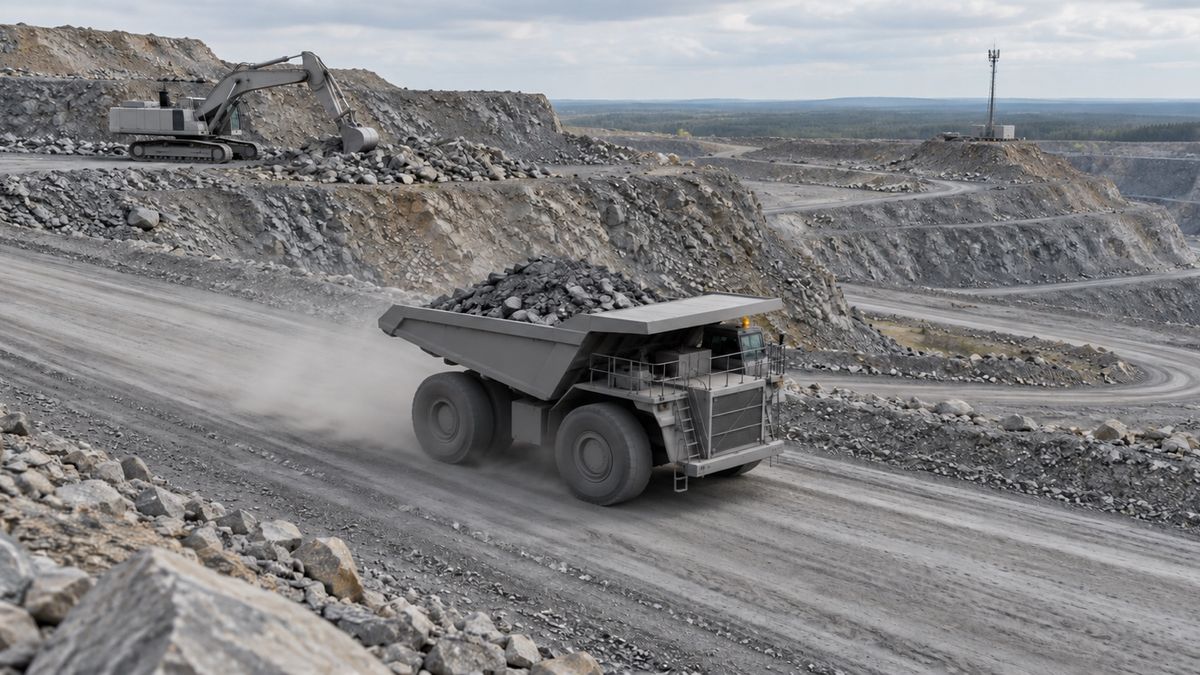
Mining Is Entering Its Intelligence Era
Mining is no longer evolving through heavier machines or larger fleets. It is evolving through intelligence.
Declining ore grades, safety expectations, and ESG mandates are pushing the industry toward a new operating model. According to the International Energy Agency report on critical minerals, demand for minerals such as lithium, copper, and nickel is expected to rise significantly to support the energy transition. International Energy Agency, The Role of Critical Minerals in Clean Energy Transitions
To remain viable, mining must become more precise, more predictive, and more autonomous.
The future autonomous mine is not simply automated. It is optimized.
From Mechanization to Autonomous Ecosystems
Mining technology has moved through clear stages:
- Mechanization replaced manual labor
- Electrification expanded operational scale
- Tele-remote systems reduced operator exposure
- Autonomous haulage introduced driverless fleets
- AI optimization connected assets into coordinated networks
Major operators such as Rio Tinto formalized this shift through large-scale autonomy programs in the Pilbara. Rio Tinto, Pilbara Operations
Today, autonomy is no longer experimental. It is strategic.
Autonomous Haulage: The Operational Backbone
Autonomous Haulage Systems represent the most mature example of mining automation.
Companies such as Komatsu commercialized Autonomous Haulage Systems at scale across Chile and Australia. Komatsu, Autonomous Haulage System
In Western Australia, Rio Tinto’s autonomous haulage program has demonstrated large-scale operational performance. Rio Tinto, Decade of Autonomous Haulage
Reported improvements across leading operations include:
- 15 percent lower haul unit costs
- 20 to 30 percent higher productivity
- 50 to 90 percent reduction in safety incidents
- Utilization rates exceeding 85 percent
- Approximately 12 percent improvement in fuel efficiency
Autonomy removes fatigue and human variability. AI algorithms continuously optimize dispatch and routing based on real-time mine conditions.
Precision Drilling and Controlled Fragmentation
Autonomous drilling systems such as the Epiroc Pit Viper series have redefined blast accuracy. Epiroc, Pit Viper Series
Modern autonomous rigs achieve:
- Plus or minus 5 cm positioning accuracy
- 35 percent reduction in hole deviation
- 20 to 25 percent increase in effective drilling hours
- Lower consumable costs
Improved drilling precision leads to better fragmentation. Better fragmentation reduces downstream grinding energy requirements, improving total system efficiency.
The Intelligence Layer That Powers Optimization
Autonomy becomes transformational when connected through digital twins and AI systems.
McKinsey & Company highlights digital twins as a major lever for asset performance. McKinsey, Digital twins and asset performance
The World Economic Forum also highlights AI-driven optimization as central to the future of advanced industries. World Economic Forum, Advanced Manufacturing and Production
This is where mining transitions from automation to orchestration.
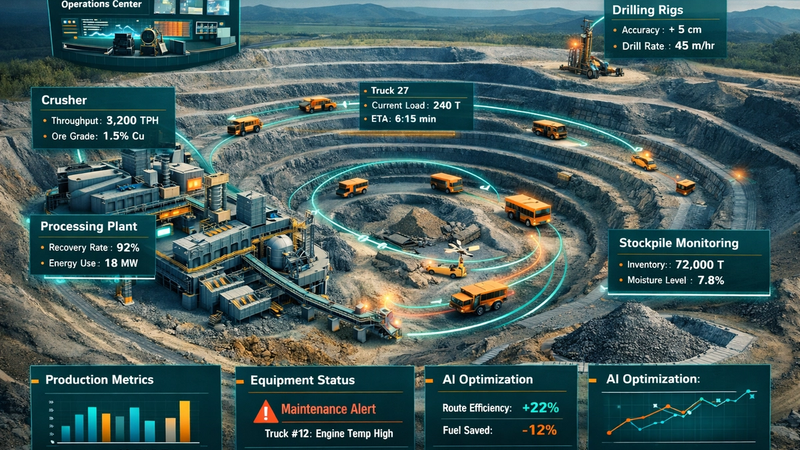
Intelligent Ore Processing and AI Sorting
AI-powered ore sorting uses hyperspectral imaging, X-ray transmission, and machine learning to classify material in real time.
Deloitte explains how AI-enabled industrial systems drive measurable cost and uptime impact. Deloitte, Predictive maintenance and Industrial AI
Quantified benefits include:
- 20 to 30 percent reduction in processing costs
- 5 to 10 percent increase in yield
- Reduced reagent usage
- Lower tailings volumes
Efficiency gains compound across the entire value chain.
Predictive Maintenance as a Stability Engine
Maintenance often represents a major portion of operational budgets in heavy industry.
AI-driven predictive maintenance frameworks analyze vibration, temperature, oil quality, and hydraulic pressure to forecast failure windows.
Deloitte notes predictive maintenance can reduce maintenance costs and improve uptime materially.
Autonomous systems depend on this stability foundation.
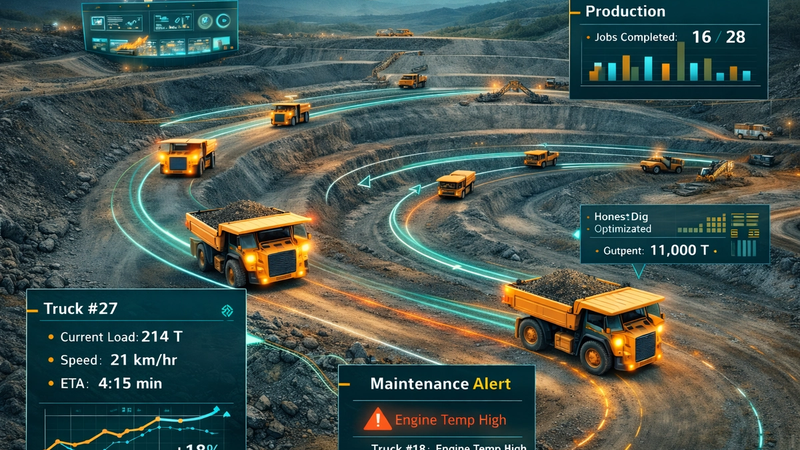
Workforce Evolution: From Operators to Orchestrators
Autonomous mines shift workforce roles from manual operation to system supervision.
The World Economic Forum Future of Jobs Report outlines how digital transformation is reshaping workforce skills across industries.
Future mining talent increasingly supports:
- AI systems
- Fleet orchestration
- Cybersecurity
- Real-time analytics
- Exception management
The mine becomes a technology environment rather than a labor-intensive one.
Cybersecurity as Operational Safety
As mining digitizes, cybersecurity becomes operational safety.
The ransomware incident that disrupted operations at Copper Mountain Mining highlighted how digital attacks can produce real physical downtime. Copper Mountain Mining
Operational resilience now includes cyber resilience.
Sustainability Through Precision
Autonomous operations reduce emissions, energy waste, and environmental exposure.
The International Council on Mining and Metals outlines climate and decarbonization pathways relevant to digital optimization and operational change. ICMM, Climate change
Reported improvements associated with automation include:
- 33 percent reduction in CO2 emissions per ton
- 20 percent reduction in energy use
- 30 percent reduction in water waste
- Lower spill incidents
Automation is becoming central to ESG performance.
Turning Autonomy Into Competitive Advantage
The shift toward AI-optimized mining is already underway.
The strategic question is how quickly organizations can orchestrate autonomy across their full value chain.
If your operation is evaluating how to transition toward intelligent, synchronized mining systems, explore how AIM by HonestDig can architect the real-time intelligence layer required to stabilize throughput, reduce operational volatility, and scale safely. AIM by HonestDig
Schedule a strategic consultation to assess your autonomy readiness.
Frequently Asked Questions
1. What is an autonomous mine?
An autonomous mine uses AI, robotics, and real-time data systems to operate equipment and coordinate processes with minimal human intervention.
2. How does AI optimize mining operations?
AI analyzes telemetry to adjust routing, maintenance timing, processing parameters, and production sequencing.
3. Are autonomous mines safer?
Yes. Removing personnel from high-risk zones significantly reduces exposure to accidents.
4. What technologies enable autonomous mining?
Autonomous haulage systems, automated drilling, digital twins, IoT sensors, predictive analytics, and AI orchestration platforms.
5. What is the biggest barrier to autonomy?
System integration, cybersecurity resilience, and workforce capability transformation.