Mining Command and Control Centre: How to Build One
Learn how to build an integrated mining command and control centre that connects systems, teams and real-time operational decisions.
How to Build an Integrated Mining Command and Control Centre
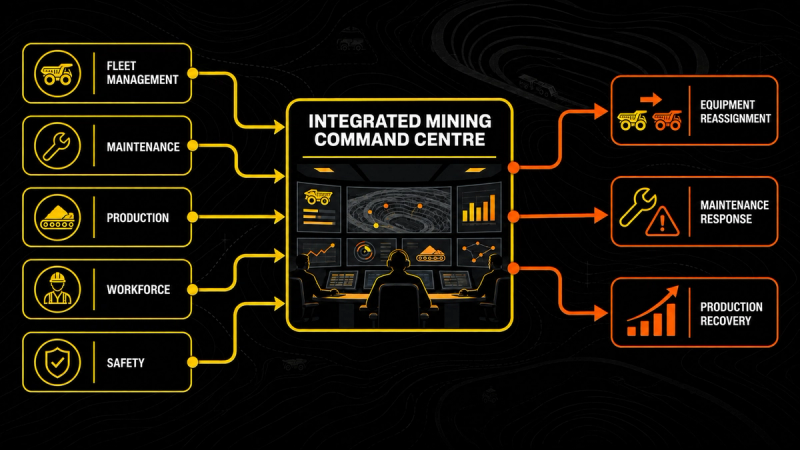
An effective mining command centre connects operational data with clear decision ownership. It is not simply a room filled with screens.
A haul truck stops during the night shift. Dispatch records the delay, maintenance receives an alert and the production team notices tonnes falling behind plan.
Each team can see part of the problem. Nobody can immediately see whether the stopped truck is the main constraint, whether another truck should be reassigned or whether the loader is already waiting.
By the time the reports are reconciled, the shift has ended.
This is the problem an integrated mining command and control centre should solve. Its purpose is not to display more data. Its purpose is to help the right person make the right operational decision while there is still time to change the outcome.
Key Takeaway
A mining command and control centre combines equipment, production, maintenance, workforce and safety information in one operational view. To work effectively, it needs common data definitions, clear decision rights, real-time alerts and workflows that turn information into action. Build the operating model first, then select the technology that supports it.
What Is a Mining Command and Control Centre?
A mining command and control centre is a central environment where teams monitor mine performance, coordinate responses and manage operational exceptions.
Depending on the operation, it may be located at the mine, in a regional office or hundreds of kilometres away. It can support one site or connect several mines.
Rio Tinto’s Operations Centre in Perth manages autonomous trucks, trains, plants and drills across its mines, ports and rail systems from approximately 1,500 kilometres away. Rio Tinto’s Western Australian operations show how one centre can connect decisions across an entire production chain.
BHP’s Integrated Remote Operations Centre connects mining hubs, processing hubs, rail and port infrastructure across its Western Australian iron ore operations. BHP reports that the centre coordinates most of its regional logistics and operating processes.
These are large-scale examples, but the underlying principle applies to mines of any size: combine fragmented information so teams can manage the operation as one connected system.
A Command Centre Is More Than a Control Room
Many mines begin by installing large screens and bringing dispatch, production and maintenance personnel into one room.
That improves visibility, but it does not automatically create control.
A display may show cycle time, equipment status and tonnes moved. If teams still use separate definitions, conflicting data or unclear escalation procedures, the room only makes disconnected information easier to see.
A working mining operations command centre needs five connected foundations:
Foundation | What it must provide |
|---|---|
Data | One reliable operational view across systems |
People | Clearly defined roles and decision authority |
Process | Agreed responses to common operational events |
Technology | Real-time monitoring, alerts and communication |
Governance | Consistent definitions, ownership and performance reviews |
Technology supports these foundations. It cannot replace them.
Start With the Decisions, Not the Screens
Before designing the room or buying software, identify the decisions that the centre must improve.
For example, what should happen when a shovel stops, a haul route closes, truck availability falls below plan or an underground heading loses communication?
For each event, define four things:
- Who detects the problem?
- Who confirms the cause?
- Who has authority to respond?
- How will the production impact be measured?
This prevents a common failure: several teams receive the same alert, but nobody knows who owns the next action.
The strongest command centres focus on operational exceptions. Routine activity continues without intervention. Controllers concentrate on situations where the plan and actual operation have started to separate.
Connect the Systems That Control the Shift
Most mines already have the necessary data. The challenge is that it sits across separate platforms.
Dispatch tracks equipment movement. The maintenance system stores work orders. The ERP records costs and inventory. Safety platforms manage incidents, while workforce systems track competency and attendance.
An integrated centre should connect the systems needed to answer three practical questions:
What is happening? Why is it happening? What should we do next?
The first integration priorities normally include fleet management, maintenance, production planning, equipment health and workforce availability.
Do not attempt to combine every data source at once. Start with the systems controlling the mine’s most important production decisions.
A practical first step is connecting real-time operational tracking with fleet, maintenance and production data. This provides a common operating view without disrupting the systems already used by individual teams.
What Mining Operations Control Software Should Provide
Effective mining operations control software should do more than collect data and display dashboards.
It should combine information from existing systems, detect meaningful deviations from plan and show the operational effect of each event. A controller should be able to move from an alert to its cause, owner and required response without searching through several platforms.
The software should also provide role-based views. A dispatch controller, maintenance planner and general manager need different levels of detail, even when they are working from the same operational information.
Finally, the platform should preserve an action history. Teams need to know what happened, who responded and whether the intervention recovered production.
These capabilities turn system integration into operational control.
Build One Version of Operational Truth
A command centre cannot work when dispatch and maintenance disagree about when downtime started or production and finance use different definitions of an operating hour.
The mine must standardise its core operational terms before combining reports.
This includes definitions for equipment availability, standby, operational delay, planned maintenance, unplanned downtime, production loss and technology failure.
It also requires a clear source for each metric. Fleet location may come from the dispatch platform, while maintenance status should come from the maintenance system.
The objective is to establish which system owns each fact, how often the information updates and how conflicting records are resolved.
This is where connected mine intelligence becomes important. It gives teams a shared operational picture built from clearly governed information.
Design Alerts Around Action
A control centre that produces hundreds of alerts per shift will quickly be ignored.
Every alert should indicate a condition that requires a decision. It should also provide enough context for the controller to act.
Instead of reporting only that a truck has stopped, the system should show how long it has been stopped, whether it carries material, whether maintenance support is available and how the delay affects the shift target.
Alerts should be prioritised by operational impact, not simply by the order in which they arrive.
A ten-minute stoppage on a non-critical support asset may require monitoring. A ten-minute stoppage at the primary loading unit may require immediate escalation.
Put Decision Rights Into the Operating Model
Centralising visibility can create conflict if site teams believe the command centre is taking control without understanding local conditions.
The centre and the site need a documented division of responsibility.
The command centre may monitor performance, identify emerging constraints and coordinate cross-functional responses. Site supervisors may retain authority over safety decisions, equipment movement and work execution.
The exact model will vary, but it must be explicit. Everyone should know which decisions are centralised, which remain on-site and when authority moves from one team to another.
Operators and supervisors should participate in the design process. They understand where delays occur, which alerts matter and which proposed workflows will fail during a real shift.
Test the Centre With Operational Scenarios
Do not judge the centre only by whether its integrations and dashboards function.
Test it with realistic operating events.
For example, simulate a shovel breakdown during peak haulage. Check whether the centre can identify the event, estimate the production impact, confirm maintenance availability and redirect trucks before queues form.
A useful test asks whether the centre can detect the event, establish the cause, assign responsibility, coordinate a response and record the result.
If the centre only shows that production declined, it is still reporting the past. It is not controlling the operation.
Roll Out the Command Centre in Phases
A mine does not need to integrate every department before it gains value.
Start with one high-value operating problem. Connect the minimum data required to manage it, test the workflow and expand after the process works consistently.
Phase | Focus | Expected result |
|---|---|---|
1. Define | Select one operational problem and assign decision ownership | Clear use case and accountability |
2. Connect | Integrate the essential data sources | Shared view of the problem |
3. Test | Run real and simulated operating scenarios | Verified response workflow |
4. Expand | Add equipment, processes or additional sites | Wider operational control |
For example, a mine may begin by connecting dispatch and maintenance information around repeated haul-truck delays.
Once the centre can identify the event, confirm ownership and coordinate recovery, the same approach can expand to loaders, crushers and workforce constraints.
This phased rollout makes improvements easier to verify and reduces operational disruption.
Measure Whether the Centre Improves Operations
A command centre should not be evaluated by the number of screens, alerts or connected systems.
Measure whether it improves operational response.
Useful measures include decision-response time, time required to identify delay causes, production-plan variance, avoidable truck queues, downtime duration and the percentage of alerts that lead to action.
The centre should also improve coordination between shifts. The incoming team should understand unresolved constraints, actions already taken and expected production impact without rebuilding the story from separate reports.
How AIM Supports an Integrated Mining Command Centre
AIM by HonestDig provides a real-time operational intelligence layer across fleet, production, maintenance and workforce information.
Teams can compare planned and actual performance, identify emerging constraints and coordinate action from one operational view.
AIM also preserves the context behind each alert. Controllers can see the affected equipment, production impact, related delays and response status without switching between separate platforms.
This turns the command centre from a reporting environment into an active operating function.
Schedule a demo to see how AIM can support an integrated mining command and control centre.
Frequently Asked Questions
What is a mining command and control centre?
A mining command and control centre is a central operating environment that connects equipment, production, maintenance, workforce and safety information to support real-time decisions.
What is the difference between a mine control room and a command centre?
A control room often monitors a specific process or area. A command centre coordinates decisions across several systems, teams or parts of the production chain.
Does a mine need autonomous equipment to use a command centre?
No. A command centre can improve coordination across manually operated, remotely operated and autonomous equipment. The main requirement is access to reliable operational data.
Which systems should connect to a mining command centre?
Most centres begin with fleet management, dispatch, maintenance, production planning and equipment-health systems. Workforce, safety, environmental and ERP data can be added where they support operational decisions.
What should mining operations control software include?
It should provide system integration, real-time monitoring, role-based views, prioritised alerts, action tracking and clear links between operational events and production impact.
Should a mining command centre replace existing fleet or maintenance systems?
No. It should connect information from specialist systems and present it in a shared operational context. Fleet and maintenance platforms should continue managing their core functions.
How should a mine begin building an integrated operations centre?
Start with one high-value operational problem. Define the decisions, owners and response process, then connect only the systems required to manage that problem. Expand after the initial workflow delivers measurable results.