Beyond the Black Box: Real-Time Visibility in Underground Mining
Discover how real-time visibility in underground mining improves safety, productivity, and operational intelligence through IoT, AI, digital twins, and private wireless networks.
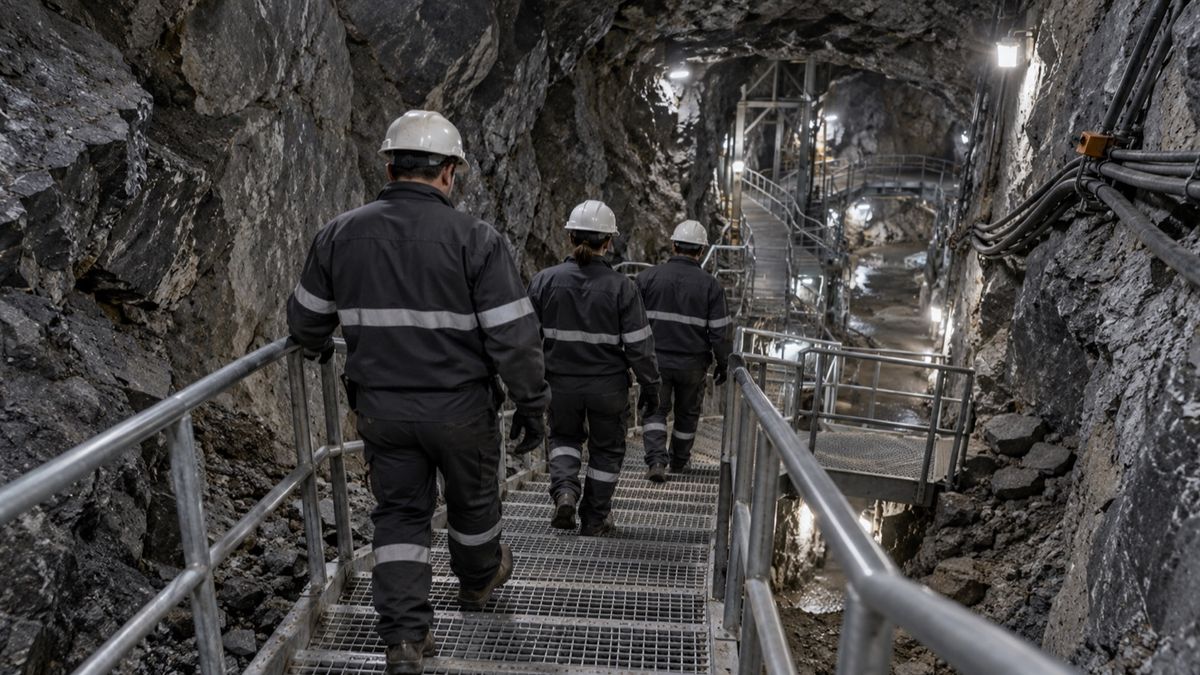
For decades, underground mines have operated like sealed systems. Once equipment and crews move below the surface, operational clarity fades. Supervisors rely on radio communication, manual logs, and end-of-shift reports.
This lack of live visibility creates operational delays, safety risks, and production inefficiencies.
Today, real-time visibility in underground mining is changing how underground operations are run. Through industrial connectivity, IoT in mining operations, spatial intelligence, and AI-driven analytics, the underground environment is becoming measurable, trackable, and easier to manage in the moment.
Connectivity as the Foundation of Real-Time Visibility in Underground Mining
Unlike surface operations, underground mines cannot depend on GPS or traditional cellular infrastructure. Rock absorbs radio waves. Dust, vibration, and narrow tunnels distort signals.
Traditional leaky feeder systems support voice communication but cannot handle the bandwidth needed for live telemetry, video, tracking, and autonomous coordination.
Modern underground mining digital transformation depends on:
- Private LTE and Private 5G networks
- Industrial Wi-Fi zones
- Fiber backhaul
- Edge computing for low-latency processing
Industry commentary highlights that robust underground connectivity is the base layer for worker tracking, equipment coordination, and emergency response, especially when mines begin scaling real-time systems. See: Cisco’s analysis on underground mining visibility and locating assets.
Without connectivity, visibility cannot exist.
IoT in Mining Operations: Turning the Underground into a Live Data Environment
Real-time visibility in underground mining begins with a sensory network.
Modern mines deploy:
- IoT gas sensors monitoring methane and carbon monoxide
- Temperature and airflow sensors integrated with ventilation systems
- Vibration sensors on drills and crushers
- Ultra-Wideband and BLE positioning tags for workers
- RFID tracking for mobile equipment
Research literature shows that underground IoT monitoring can maintain reliable telemetry even in complex environments when networks and sensors are engineered for the conditions. See: Underground monitoring research on IoT communication approaches.
This converts reactive safety management into proactive response.
Instead of reacting to gas spikes after they occur, supervisors get alerts in real time. Instead of searching for vehicles during shift change, teams see exact equipment positions instantly.
Spatial Intelligence Through Underground Mine Digital Twins
Visibility is not only about sensor readings. It needs spatial context.
LiDAR scanning and SLAM mapping create accurate 3D models of tunnels and stopes. These feed into an underground mine digital twin, a live virtual model that updates as the mine changes.
A digital twin helps teams:
- Simulate blast and traffic scenarios before execution
- Optimize haulage routes and reduce congestion
- Inspect unstable areas remotely
- Model evacuation routes based on live conditions
When this spatial layer is connected to an intelligence layer like AIM by HonestDig, sensor streams turn into coordinated operational decisions, not just dashboard visuals.
AI in Underground Mining
Data volume underground can be overwhelming. AI makes visibility usable by spotting patterns and risks humans cannot detect quickly enough.
AI in underground mining supports:
- Computer vision detection of loose rock hazards
- Live risk detection for vehicle interactions
- Predictive maintenance for drills, loaders, and critical plant assets
- Automated identification of unsafe zone entry
- Short interval operational control using live production signals
This is where visibility turns into action, not just reporting.
If your underground program is tied to throughput and production stability, Guaranteed Production Throughput fits naturally as the execution layer that links visibility to measurable output.
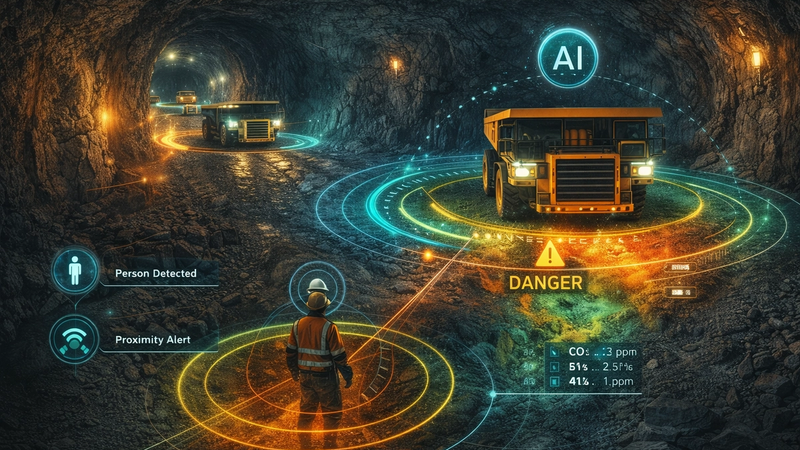
Collision Avoidance and Automated Safety
Vehicle interaction remains one of the highest risk areas underground.
Modern collision avoidance systems in mining combine:
- Sub-meter positioning accuracy
- Multi-zone proximity detection
- Context-aware alerts
- Automated speed reduction and emergency stops when required
With reliable underground networks and edge processing, response times move closer to real time, reducing the window where small mistakes become incidents.
If part of your visibility challenge is also workforce coordination, access control, and zone compliance, Autonomous Workforce Governance supports that operational layer naturally.
The Economics of Real-Time Visibility
Real-time visibility in underground mining improves:
- Equipment utilization
- Shift productivity
- Ventilation efficiency
- Maintenance planning
- Emergency response coordination
Even small improvements compound.
Recovering 20 to 30 minutes of productive time per shift through better locating and dispatch coordination can add meaningful output across the year.
Ventilation-on-demand also benefits from visibility. When airflow adapts to real-time personnel and equipment presence, energy waste drops and safety improves. For operations building resilience across safety and environment together, Predictive Site Resilience connects well to this requirement.
The Practical Challenges to Solve
Real-time visibility is achievable, but implementation must account for:
- Signal attenuation and multipath distortion in rock
- Rugged hardware requirements
- Interoperability across multiple OEM systems
- Upskilling and adoption across crews
- Change management and trust in automated alerts
The solution is rarely a single tool. It is an architecture.
Connectivity → Sensors → Spatial Model → AI layer → Command view → Operational response
Turning the Black Box Into a Live Operational System
The underground mine no longer has to be a blind environment where decisions happen after the shift ends.
Real-time visibility in underground mining is becoming the base requirement for:
- Safer underground operations
- Faster incident response
- Better cycle time control
- Stronger production reliability
- Scalable autonomy
If you want to map what real-time visibility could look like for your site, start with AIM by HonestDig and identify where the biggest information gaps are happening today, such as location, ventilation, asset health, or bottleneck visibility.
Frequently Asked Questions
1. What is real-time visibility in underground mining?
Continuous monitoring of people, equipment, and conditions using sensors, tracking, and live operational systems.
2. Why is connectivity difficult underground?
Rock blocks signals and tunnels create interference, so mines need engineered private networks and backhaul.
3. What is an underground mine digital twin?
A live 3D model of the mine that updates with operational data to support planning, response, and optimization.
4. Does visibility reduce downtime?
Yes. Better tracking plus predictive signals help prevent delays from becoming extended stoppages.
5. Is full autonomy possible without visibility?
No. Autonomy depends on location certainty, hazard detection, and low-latency decision loops.