6 Cat MineStar Alternatives for Mining in 2026
Compare six Cat MineStar alternatives for fleet dispatch, mine control and operations intelligence. See where each platform fits before you shortlist.
6 Cat MineStar Alternatives for Mining in 2026
Compare leading alternatives for fleet dispatch, production control and mining operations intelligence before replacing or extending Cat MineStar.
A mine begins reviewing alternatives after several years on Cat MineStar. The initial request sounds simple: find another mining fleet management platform.
Then the evaluation team starts asking questions.
Are they replacing fleet dispatch, equipment health, machine guidance, safety or autonomous haulage? Do they want to remove MineStar entirely, or do they need better intelligence across MineStar and other systems?
The answer changes the shortlist.
Cat MineStar is not one product. It is a suite covering Fleet, Terrain, Detect, Health and Command. No alternative provides a genuine like-for-like replacement until the mine defines which capabilities it currently uses and which operational gaps it needs to solve.
Key Takeaway
The leading Cat MineStar alternatives in 2026 include Komatsu DISPATCH, Hexagon OP Pro, Wencomine FMS, Micromine Pitram, ABB Ability Operations Management System and AIM by HonestDig. Komatsu, Hexagon and Wenco focus strongly on surface fleet management. Pitram specialises in underground production control. ABB connects planning with shift execution, while AIM provides an operations intelligence layer across existing fleet, workforce and business systems.
What Does Cat MineStar Currently Cover?
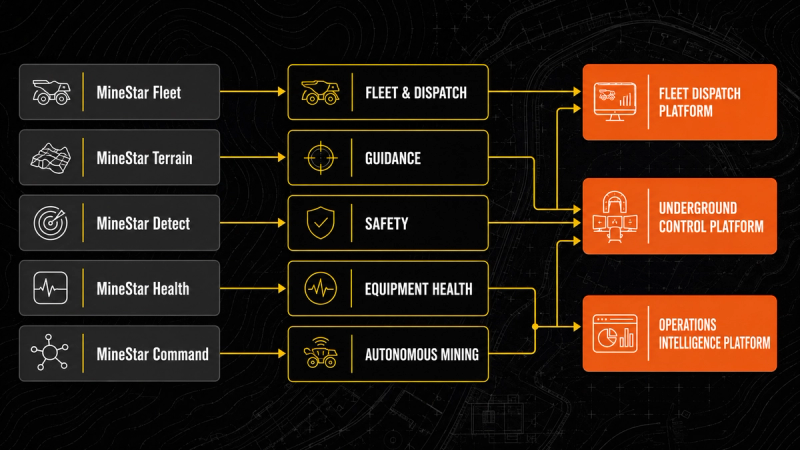
Cat MineStar brings several mining technology capabilities into one product family:
- Fleet supports fleet tracking, material movement, dispatch and production monitoring.
- Terrain provides machine guidance and design information.
- Detect addresses safety risks such as proximity, fatigue and operator awareness.
- Health supports equipment condition and maintenance decisions.
- Command covers remote, semi-autonomous and autonomous equipment operation.
A platform that competes with MineStar Fleet will not automatically replace MineStar Health or Command. Similarly, mining operations software can connect information across the site without replacing the onboard systems responsible for dispatch or machine control.
Before comparing MineStar competitors, document the modules, integrations, equipment interfaces and operational workflows currently in use.
Signs the Current MineStar Setup No Longer Fits
Replacing a working system creates cost and operational risk. A mine needs a clearer reason than licence dissatisfaction or interest in a newer dashboard.
Common signals include:
- Mixed-fleet information remains divided across OEM systems.
- Teams export MineStar data into spreadsheets for cross-system analysis.
- Dispatch decisions remain disconnected from maintenance or workforce availability.
- The mine needs underground workflows that the current setup does not cover.
- Adding more modules will not solve the underlying integration problem.
- Site leadership wants one operational view across fleet, workforce, production and ERP data.
The last point is particularly important. If the problem sits above fleet dispatch, replacing one fleet management system with another may reproduce the same visibility gap under a different interface.
Disclosure and Comparison Method
HonestDig publishes this guide and provides AIM, one of the platforms included below. The order is based on software category, not product ranking.
The comparison begins with surface fleet-dispatch platforms, followed by underground mine control and broader operations-management systems. Each product is assessed according to its stated capabilities, strongest differentiator and practical selection boundary.
Cat MineStar Alternatives at a Glance
Platform | Primary differentiator | Best suited to | What it does not replace alone |
|---|---|---|---|
Komatsu DISPATCH | Mature truck and shovel optimisation within the Modular ecosystem | High-volume surface load and haul operations | MineStar Detect, Health or a complete operations layer |
Hexagon OP Pro | Fleet management connected with Hexagon machine guidance, planning and safety tools | Open-pit mines building around the Hexagon environment | The complete MineStar autonomy and equipment-health suite |
Wencomine FMS | Open interoperability for mixed-equipment fleets | Surface mines limiting dependence on one OEM stack | Broader workforce or enterprise operations management |
Micromine Pitram | Underground hard-rock production control | Underground mines managing equipment, personnel and material movement | A surface autonomous haulage suite |
ABB Ability OMS | Closed-loop scheduling and short-interval production control | Mines connecting planning, tasks, people and equipment | A direct onboard dispatch replacement in every deployment |
AIM by HonestDig | Connected intelligence across fleet, workforce and operational systems | Mines with fragmented data and cross-functional control gaps | Onboard machine guidance or autonomous equipment control |
Surface Fleet Dispatch Alternatives
1. Komatsu DISPATCH
Komatsu DISPATCH is the most direct option on this list for mines replacing the core load and haul functions of MineStar Fleet.
It provides real-time control across loading and hauling operations, with truck and shovel assignment, queue management and fleet optimisation. The wider Modular ecosystem adds machine guidance, fuel management, payload tools and AI-supported optimisation.
Its key differentiator is the depth of its truck and shovel optimisation environment. DISPATCH fits high-volume surface mines where haulage efficiency, material movement and dispatcher control drive the business case.
It is less relevant when the primary problem is workforce coordination, enterprise reporting or intelligence across several non-fleet systems.
For a deeper comparison, review the Modular Mining DISPATCH alternatives guide.
Best fit: Large surface operations focused on load and haul productivity.
Verify: Mixed-fleet compatibility, onboard hardware, integration requirements and alignment with current or planned autonomous haulage.
2. Hexagon OP Pro
Hexagon OP Pro provides real-time fleet tracking, production-cycle management and visibility into equipment utilisation for open-pit mines.
Hexagon’s main differentiator is the breadth of its connected mining environment. OP Pro can work alongside Hexagon machine guidance, MinePlan, safety and operational technology products. This gives mines a clearer expansion path from fleet dispatch into guidance and broader site workflows.
Choose OP Pro over another surface FMS when the operation values alignment between fleet activity, mine planning and machine guidance within one vendor environment.
That same strength creates an important evaluation question. Buyers must distinguish between capabilities included in OP Pro and those delivered through separate Hexagon products or hardware.
Best fit: Open-pit mines seeking fleet management within the broader Hexagon mining stack.
Verify: Required modules, onboard equipment, third-party interfaces and the full implementation scope.
3. Wencomine FMS
Wencomine FMS manages equipment location, activity, production progress and machine status in real time.
Its clearest differentiator is open interoperability. Wenco appeals to mixed-fleet mines that do not want their operational data restricted to one OEM’s technology stack. It can also connect with Wenco machine guidance, asset-health tools and Hitachi autonomous haulage capabilities.
Choose Wenco when OEM flexibility and access to mixed-equipment data matter more than staying inside one manufacturer’s digital environment.
Open positioning does not guarantee that every interface will work out of the box. The evaluation team should test each important OEM, model and onboard system using site-representative data.
For further comparison, see the full guide to Wenco alternatives.
Best fit: Mixed-fleet surface operations prioritising interoperability.
Verify: Available interfaces for each equipment type, data ownership and integration effort.
Underground Mine Control Alternative
4. Micromine Pitram
Micromine Pitram provides mine control, fleet management and production data capture across equipment, personnel, materials and mine activities.
Its strongest differentiator is underground hard-rock production control. Pitram addresses the practical challenges of tracking work, equipment and material movement where GPS coverage does not exist and communications infrastructure varies across the mine.
Choose Pitram when underground visibility and production coordination lead the requirement. It is not positioned as a complete replacement for MineStar’s surface autonomy, machine-health and safety portfolio.
Best fit: Underground hard-rock mines requiring production control, material tracking and equipment visibility.
Verify: Underground positioning, network coverage, onboard data capture and integration with planning and maintenance platforms.
Operations Management and Intelligence Alternatives
5. ABB Ability Operations Management System
ABB Ability Operations Management System connects production plans with tasks, equipment, workforce and process execution.
Its key differentiator is closed-loop production control. ABB OMS supports short-interval control, operational replanning, work assignment and what-if analysis across open-pit and underground mines.
This makes ABB different from a conventional mine dispatch software platform. Its central purpose is to connect high-level plans with changing site conditions so teams can correct production variance during the shift.
Choose ABB OMS when the control gap exists between mine planning and execution. Confirm whether the deployment also requires a separate fleet-dispatch system underneath it.
Best fit: Mines seeking short-interval control and integrated production scheduling.
Verify: Required dispatch capabilities, IT and operational technology integrations, and how frontline teams will update task status.
6. AIM by HonestDig
AIM by HonestDig connects fleet, workforce and operational data within one intelligence and control layer.
Its primary differentiator is cross-functional operational coordination. AIM focuses on how fleet activity, workforce execution, maintenance constraints and site conditions combine to affect production performance.
Choose AIM when the mine already has fleet, ERP or maintenance systems but leadership still lacks a reliable, real-time operating picture. AIM sits above those tools, using their data to support decisions across functions.
It is not a replacement for onboard machine guidance or autonomous equipment control. Its value comes from connecting the decisions that remain divided across existing platforms.
AIM also supports use cases involving autonomous workforce governance, production throughput and predictive site resilience.
Best fit: Mines with capable point systems but fragmented operational control.
Verify: Which existing systems will remain, what data they expose and which decisions AIM will manage directly.
How to Select the Right MineStar Alternative
Do not begin with vendor demonstrations. Begin with the operating constraint.
A mine replacing MineStar because dispatch optimisation is weak needs a different product from a mine struggling with mixed-fleet data, underground visibility or disconnected production decisions.
A structured mine dispatch software evaluation checklist should answer five questions:
- Which MineStar modules and workflows are currently in use?
- Which capabilities must the alternative replace from day one?
- Which systems, hardware and data histories must remain?
- Can the platform operate under actual site connectivity conditions?
- Which measurable KPI should improve after implementation?
Test the platform during a real operating cycle. Measure queue time, utilisation, cycle consistency, dispatcher workload, production variance or another outcome connected to the original problem.
The Migration Risk Most Mines Underestimate
The hardest part of a MineStar migration is not always the dispatch cutover. It is maintaining the meaning of operational data.
Delay codes, asset identifiers, equipment states, material names and location structures often differ between systems. If those definitions change during migration, the mine may lose the ability to compare performance before and after implementation.
A clean new dashboard can still contain misleading trends when historical and current states do not match.
Map these definitions before configuration begins. Preserve the logic behind historical records, not only the records themselves. Then test one fleet, pit, process or shift before expanding the system across the site.
Select the Platform That Fits the Control Gap
Choose Komatsu DISPATCH when truck and shovel optimisation leads the business case. Choose Hexagon OP Pro when fleet management must connect with Hexagon planning and guidance. Choose Wenco when mixed-fleet interoperability is the priority.
Pitram fits underground production control. ABB OMS fits plan-to-execution coordination. AIM fits mines that need intelligence and control across fleet, workforce and existing operational systems.
The best Cat MineStar alternative is not the platform with the longest feature list. It is the one that solves the defined control gap without creating a new integration problem.
To assess whether AIM can extend or replace specific parts of your current mining technology environment, speak with HonestDig.
Frequently Asked Questions
What is the closest alternative to Cat MineStar Fleet?
Komatsu DISPATCH, Hexagon OP Pro and Wencomine FMS are the closest alternatives for surface fleet management. Each differs in optimisation depth, connected products and interoperability.
Can one platform replace the complete MineStar suite?
Rarely. MineStar covers fleet management, guidance, safety, equipment health and autonomy. Most mines need several integrated products or retain selected MineStar modules.
Can a mine keep MineStar Fleet and add another platform?
Yes. An operations intelligence or production-management platform can use data from an existing fleet system when MineStar and the additional platform support the required integrations.
Which MineStar alternative is best for mixed fleets?
Wenco has a strong interoperability position for mixed fleets. Hexagon and Komatsu also support mixed-equipment environments, but compatibility should be verified for every OEM and onboard system.
Which MineStar alternative suits underground mining?
Micromine Pitram specialises in underground production control. ABB OMS also supports underground operations where scheduling and plan-to-execution coordination lead the requirement.
What should a MineStar replacement pilot measure?
Measure one defined operational outcome, such as reduced queue time, higher utilisation, faster response to delays or improved plan attainment.
What data must be mapped before migration?
Map asset identifiers, delay codes, equipment states, material definitions, locations, timestamps and production events before transferring historical or live data.