Haul Truck Payload Optimization: Cost per Tonne Guide
Discover how haul truck payload optimization reduces underloading, overloading, and tire stress to lower mining cost per tonne.

How Underloading and Overloading Affect Cost per Tonne
Haul truck payload optimization is not about making every load as heavy as possible. It is about moving the required tonnes at a sustainable cost while protecting cycle performance, tires, and asset life.
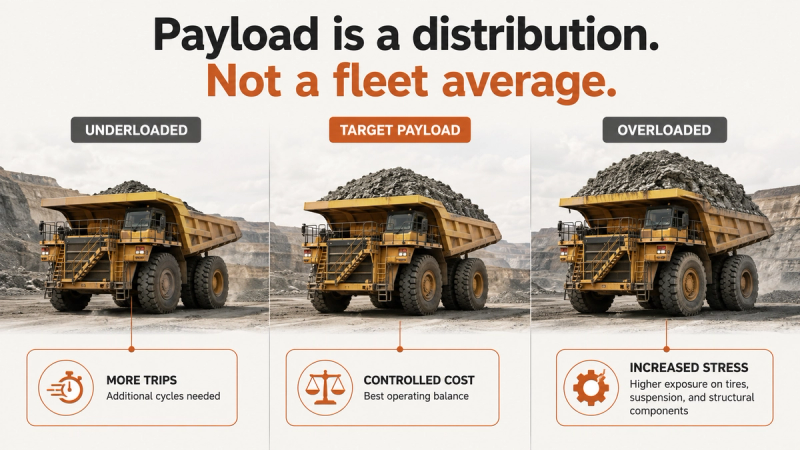
A fleet average can hide underloaded and overloaded trips that increase fuel use, maintenance exposure, and mining cost per tonne.
How Payload Changes Mining Cost per Tonne
Cost per tonne = (Fixed costs + Variable operating costs) ÷ Actual tonnes moved
Haul truck underloading reduces the denominator. The truck completes nearly the same cycle while moving fewer tonnes, requiring more trips and engine hours.
Haul truck overloading temporarily increases tonnes moved, but it can also raise fuel demand, tire workload, structural loading, and component exposure. Caterpillar notes that overloading can increase fuel burn, reduce component and tire life, and cause structural damage.
Payload Condition | Operational Effect | Cost Risk |
|---|---|---|
Underloaded | Fewer tonnes per cycle | More trips and operating hours |
Near target | Stable use of rated capacity | More predictable unit cost |
Overloaded | More tonnes on one trip | Higher tire, fuel, and component exposure |
Research on surface mine haulage shows that payload variance can influence truck bunching, cycle time, material movement, and fuel consumption. A heavily loaded truck that loses speed on a ramp can delay following trucks.
Establishing a Mining Truck Payload Management Baseline
Begin with at least 30 days of validated payload data. Each record should identify the truck, loading unit, material source, shift, destination, and measured payload.
Track mean payload, variation, underloaded and overloaded trips, and loads above the approved maximum. Segment results by truck, shovel, material, route, and shift. A narrow distribution around target is more useful than a misleading fleet average.
Caterpillar’s 10/10/20 framework is one example of an OEM payload policy. It states that no more than 10% of loads should exceed 110% of target, no load should exceed 120%, and mean payload should remain at or below target. Site-specific equipment and operating limits govern the final policy.
Root Causes of Payload Variance in Mining Operations
Payload variance in mining operations is rarely an operator-only issue. Common causes include calibration, material density, fragmentation, pass-count rules, carryback, uneven loading, and delayed feedback.
Map variance against the loading unit, truck, material source, route, and shift. Repeated overloads from one shovel may indicate calibration or pass-matching problems. Underloading in lighter material may show that a fixed pass rule is not accounting for density.
Scale studies using truck scales or bed scanners can validate onboard readings, identify carryback, and improve payload accuracy.
Haul Truck Payload Monitoring at the Loading Point
A weighbridge confirms the result after the loading decision. Effective haul truck payload monitoring provides feedback while the truck is still at the shovel.
Some truck payload systems use suspension strut pressure sensors and onboard processors to estimate payload. External loading lights can show the loading operator when the target has been reached.
The loading operator and dispatcher should receive a record linked to the truck, shovel, material, route, and timestamp. Connect it with haul truck cycle-time analysis to evaluate payload alongside loading time, queues, travel speed, and dumping time. This supports open-pit haul truck efficiency by allowing correction before the truck enters the circuit.
Connect Payload with Tire and Maintenance Exposure
Review payload with gross machine weight, axle distribution, grade, speed, haul distance, road condition, and tire rating.
TKPH, or tonne-kilometer per hour, combines mean tire load with average work-shift speed. Bridgestone explains that heavy hauling generates tire heat and that operation beyond rated TKPH can cause early deterioration or serious damage.
Connect payload monitoring with tire events, suspension condition, frame inspections, axle work, and final-drive maintenance. The mining equipment maintenance KPI guide can help compare overload exposure with reliability trends.
Make Payload Control a Weekly Routine
Review payload weekly with dispatch, loading, maintenance, and planning teams. Compare it with fuel per tonne, cycle time, tire events, and planned-versus-actual production.
Use a simple control loop:
Measure → Validate → Diagnose → Correct → Monitor
The objective is to identify repeatable system conditions before they affect throughput or asset life.
From Payload Events to Operational Intelligence
Payload data often sits across disconnected onboard, dispatch, maintenance, and production systems. Teams may see an overload without seeing its effect on cycle performance or maintenance risk.
AIM by HonestDig addresses this operational blind spot by connecting payload and fleet signals with maintenance readiness, production priorities, and guaranteed production throughput.
Frequently Asked Questions
What is haul truck payload optimization?
Haul truck payload optimization controls load distribution around the approved target using calibrated measurement, loading feedback, dispatch data, cycle-time analysis, and maintenance monitoring.
How does haul truck underloading affect mining cost per tonne?
Haul truck underloading moves fewer tonnes while most cycle costs remain. More trips may be needed to achieve the same target, increasing mining cost per tonne.
What are the risks of haul truck overloading?
Haul truck overloading can increase fuel demand, tire heat, structural loading, component wear, speed loss on grade, and truck bunching.
What is the 10/10/20 payload policy?
The Caterpillar 10/10/20 policy limits the frequency and severity of loads above target. Sites should apply the limits specified for their equipment and conditions.
How does haul truck payload monitoring improve open-pit haul truck efficiency?
Haul truck payload monitoring provides timely information about underloads, overloads, and payload variance. It supports consistent loading, cycle control, tire management, and production planning.
Optimize Lifetime Production, Not a Single Load
The objective of haul truck payload optimization is not the heaviest possible trip. It is a controlled payload distribution that protects open-pit haul truck efficiency and delivers the lowest sustainable cost across the fleet’s operating life.
Request a payload intelligence walkthrough to see how HonestDig connects shovel, truck, dispatch, maintenance, and production signals in one operational view.