How to Find Mine Production Bottlenecks Before Adding Equipment
Learn how mining teams identify production bottlenecks, optimize throughput, and avoid unnecessary equipment investments using operational data.
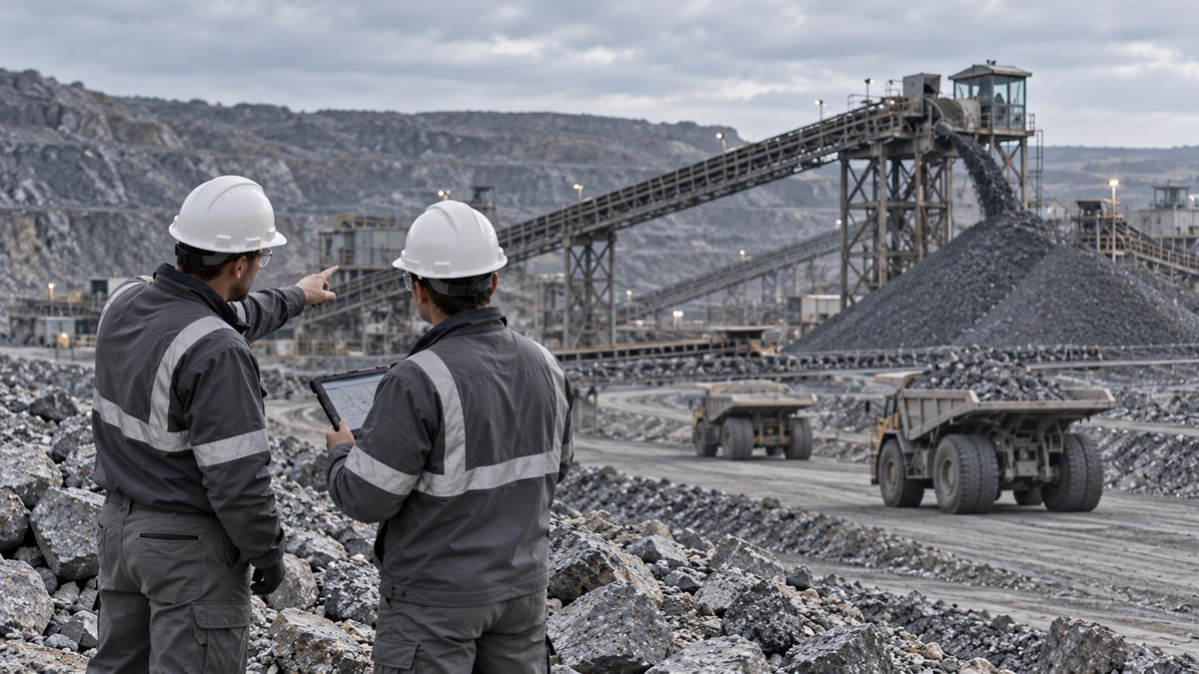
When production falls below target, the first solution is often adding more equipment.
A mine may consider purchasing additional haul trucks, increasing loader capacity, or expanding the fleet.
But adding equipment does not always increase production.
The real constraint may be somewhere else.
A mine with enough trucks can still lose production because of shovel delays, poor dispatch decisions, increasing cycle times, crusher limitations, or maintenance issues.
Before making a major capital investment, mining teams need to answer one question:
What is actually limiting throughput today?
Identifying mine production bottlenecks requires understanding how equipment, processes, and operational decisions work together across the entire mining value chain.
Key Takeaway
Mine production bottlenecks are not always caused by insufficient equipment. By analyzing factors such as truck-shovel match factor, cycle times, utilization, delays, and downstream constraints, mining teams can improve throughput and make better investment decisions.
The Equipment Shortage Problem That May Not Be an Equipment Problem
Mining operations are connected systems.
The production chain typically includes:
- Drilling and blasting
- Loading
- Hauling
- Crushing
- Stockpiling
- Processing
A constraint in one area can affect everything downstream.
For example:
A mine may believe it needs additional haul trucks because production targets are not being achieved.
However, operational analysis may show that trucks are already spending significant time waiting at the shovel.
Adding more trucks in this situation does not solve the problem. It increases fleet size while the actual bottleneck remains unchanged.
The result:
- Higher capital expenditure
- Increased maintenance costs
- More fuel consumption
- Limited production improvement
The first step is understanding where the production system is restricted.
Finding the Real Constraint Inside a Mining Operation
Start With the Truck-Shovel Match Factor
One of the most important concepts in mine production planning is the truck-shovel match factor.
The match factor measures whether the available hauling capacity matches loading capacity.
A simple interpretation:
- Match factor below 1: Shovels or loaders may spend time waiting for trucks.
- Match factor above 1: Trucks may spend time queueing because loading capacity is limited.
For example:
A mine may have six trucks assigned to a shovel, but if loading capacity supports only four trucks efficiently, the additional trucks create waiting time instead of additional production.
Before buying more trucks, teams should understand whether the issue is insufficient haulage capacity or poor fleet balance.
A Small Operational Delay Can Create a Large Production Loss
Consider a mine operating:
- 12 haul trucks
- 20 cycles per shift
- 8 minutes of queue time per cycle
Across the shift, this creates significant lost operating time.
Those lost minutes may represent the equivalent productivity of an additional truck that the mine does not actually need.
Instead of increasing fleet size, improving:
- Dispatch decisions
- Loading balance
- Queue management
- Cycle time performance
may recover existing capacity.
This is why mining productivity improvement often starts with better operational visibility, not additional assets.
The Crusher Can Be the Real Mining Bottleneck
Not every bottleneck exists in the pit.
Sometimes the constraint appears downstream.
Examples include:
- Crusher capacity limitations
- Dump point congestion
- Stockpile restrictions
- Processing delays
A mine can increase truck movement and loading capacity, but if the crusher cannot process additional material, the queue simply moves to another part of the operation.
This is why mine throughput optimization requires visibility across the complete production chain, not only fleet performance.
A Practical Four-Step Approach to Identify Mine Production Bottlenecks
1. Compare Planned vs Actual Performance
Start by understanding where production is falling behind.
Review:
- Planned tonnes versus actual tonnes
- Shift performance
- Equipment allocation
- Delay reasons
This identifies where the gap begins.
2. Analyze Equipment Utilization and Movement
Review:
- Truck cycle times
- Idle time
- Queue time
- Equipment availability
- Loading efficiency
For example, high truck waiting time may indicate a dispatch or loading issue rather than a fleet shortage.
Understanding unplanned equipment downtime in mining also helps identify whether reliability issues are affecting production.
3. Identify the Constraint Limiting Throughput
Ask:
- Are trucks waiting?
- Are loaders waiting?
- Is the crusher operating at capacity?
- Are delays concentrated around specific activities?
The constraint is the activity limiting the entire system.
Improving the wrong area may simply move the bottleneck somewhere else.
4. Validate Improvements Before Investing in Equipment
Before approving additional capital expenditure:
- Identify the constraint
- Apply an operational improvement
- Measure production impact
- Decide whether additional equipment is still required
This approach helps mining teams avoid investing in equipment when the actual opportunity exists within current operations.
Why Real-Time Operational Intelligence Matters
Finding bottlenecks is not a one-time exercise.
Mining conditions change constantly.
A bottleneck today may not be the same bottleneck next month.
For example:
- Improving truck availability may reveal shovel limitations.
- Increasing shovel productivity may shift the constraint to crushing.
- Improving crusher capacity may reveal haulage limitations.
This continuous movement is why mining teams need real-time visibility.
Operational intelligence helps connect data from:
- Fleet systems
- Maintenance platforms
- Production systems
- Equipment monitoring tools
Teams can use this information to understand where losses occur and what action creates the biggest impact.
Learn more about real-time operational intelligence in mining.
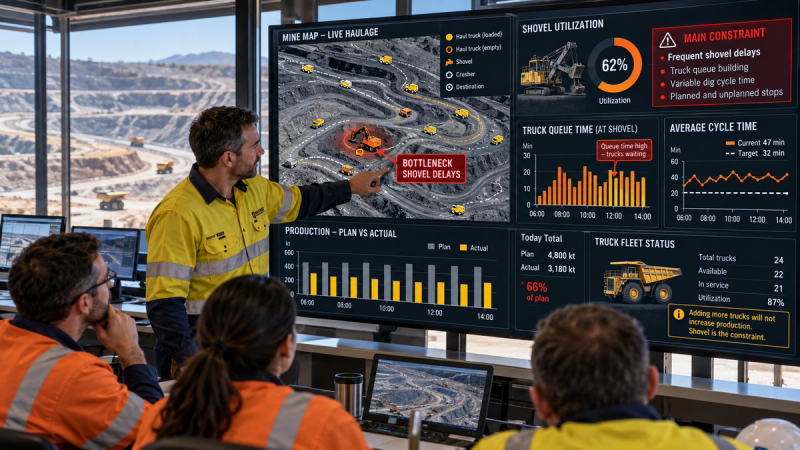
How AI Helps Identify Hidden Production Constraints
AI mining software can help teams analyze operational patterns that are difficult to identify manually.
Examples include:
- Cycle time increases after shift changes
- Repeated delays during specific weather conditions
- Equipment performance trends
- Recurring dispatch issues
Instead of only reporting that production dropped, AI can help identify why it happened.
For example, AI may detect that haul cycle times consistently increase after rainfall on a specific route, allowing teams to plan alternative actions earlier.
Learn how AI in open-pit mining operations supports better operational decisions.
Improve Throughput Before Increasing Capital Investment
Adding equipment may be necessary for some mining operations.
However, the decision should come after understanding the real production constraint.
By improving:
- Fleet utilization
- Dispatch decisions
- Maintenance response
- Workflow coordination
- Operational visibility
mines can often unlock additional capacity from existing resources.
Solutions focused on Guaranteed Production Throughput help mining teams identify operational gaps and improve production consistency.
HonestDig helps mining operations connect operational data with actionable insights to improve throughput, reduce inefficiencies, and make better decisions.
Frequently Asked Questions
What are mine production bottlenecks?
Mine production bottlenecks are constraints that limit overall output. They can occur due to equipment availability, loading capacity, haulage limitations, crusher capacity, maintenance issues, or inefficient operational processes.
Why should mines identify bottlenecks before buying equipment?
Adding equipment without understanding the actual constraint can increase costs without improving production. Bottleneck analysis helps determine whether the issue is capacity, utilization, or process efficiency.
What is truck-shovel match factor in mining?
Truck-shovel match factor measures whether hauling capacity is balanced with loading capacity. A low value may indicate loaders waiting for trucks, while a high value may indicate trucks waiting for loaders.
How does real-time data help identify mining bottlenecks?
Real-time operational data helps teams monitor equipment performance, cycle times, delays, and production trends to identify constraints while operations are active.
Can AI improve mining bottleneck analysis?
Yes. AI can analyze operational patterns, detect recurring issues, and help mining teams predict potential production constraints before they impact throughput.