Mining Operations Management Software Buyer’s Guide
Compare the features, users and evaluation criteria of mining operations management software before selecting a platform for your mine.
Mining Operations Management Software Features, Users and Evaluation
Understand what mining operations management software controls, who uses it and how to evaluate whether a platform can improve production performance across the mine.
A shift supervisor begins the day with a production target, an available fleet and a clear mine plan. Within two hours, one loader is waiting for trucks, a haul road restriction has increased cycle time and maintenance has removed another unit from service.
Dispatch sees part of the problem. Maintenance sees another. Management receives the complete picture only after the shift ends.
This is the operational gap that mining operations management software closes. It connects equipment, crews, tasks and production activity so teams can identify deviations and respond while there is still time to protect the shift target.
Key Takeaway
Mining operations management software provides real-time control over production, equipment, workforce and site activity. It helps dispatchers, supervisors, maintenance teams and mine managers coordinate decisions using one operational view. The right system should improve throughput, equipment utilisation, production consistency and cost per tonne, not simply generate more operational data.
What Is Mining Operations Management Software?
Mining operations management software is a digital platform used to monitor, coordinate and improve the execution of mining activities.
It connects live operational data with the mine plan. Teams can see what is happening, understand why performance has changed and take corrective action during the shift.
The software may cover load and haul operations, fleet dispatch, equipment activity, production progress, workforce allocation, maintenance readiness, material movement, safety workflows and shift reporting.
Its configuration will depend on whether the operation is an open-pit mine, an underground mine or a multi-site mining business.
In every case, the objective remains the same: turn disconnected operational information into coordinated action.
Why Existing Mining Systems Leave an Operational Gap
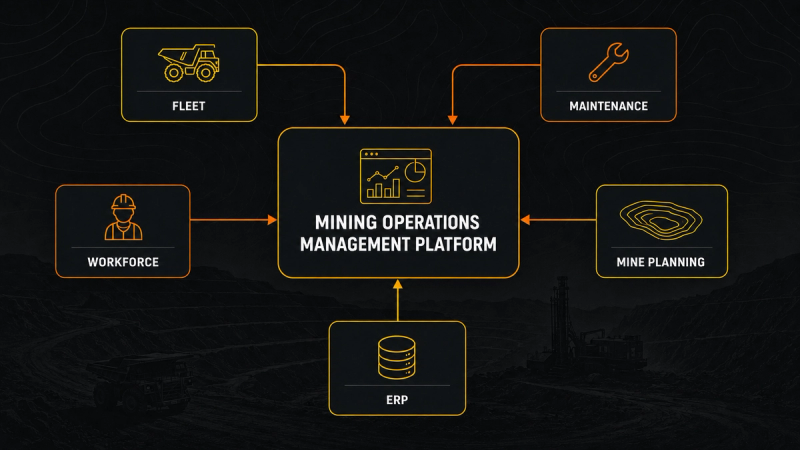
Most mines already use several digital systems. An ERP manages financial and procurement records. Maintenance software manages inspections and work orders. Fleet software tracks mobile equipment. Mine planning tools define where and how material should be extracted.
Each system performs an important function, but each sees only one part of the operation.
Problems develop when production teams must combine these views manually. Dispatch may assign a truck without knowing that maintenance plans to remove it from service. A supervisor may see falling tonnes without knowing whether queue time, road conditions, payload variance or workforce delays caused the loss.
This is why understanding the difference between fleet management software and operations intelligence matters.
Fleet tracking tells the mine where its equipment is. A mine management system must help teams decide what should happen next.
Core Features of Mining Operations Management Software
A strong platform should support daily execution and operational decisions, not simply produce additional dashboards.
Real-Time Operational Visibility
The platform should display equipment location, status, assignments, queues, cycle activity, crew deployment and production progress in real time.
Dispatchers and supervisors need current information. Data that arrives after the opportunity to intervene has passed supports reporting, but it does not support operational control.
Production and Throughput Control
The system should continuously compare planned and actual production. Supervisors must be able to identify where a variance started and what action could help recover the target.
Relevant measures include tonnes moved, material destination, cycle time, payload, queue time, loader performance and equipment utilisation.
Software focused on production throughput should connect these measures to the decisions that influence them.
Fleet Dispatch and Task Coordination
Fleet dispatch should consider equipment availability, location, route conditions, material requirements and current production priorities.
Underground operations may also require heading assignments, loader and truck matching, restricted-area management and task coordination across multiple levels.
The goal is not simply to issue instructions. The system must keep work aligned with the mine plan as site conditions change.
Equipment and Maintenance Visibility
Operations teams need to know whether equipment is operating, idle, delayed, unavailable or approaching a maintenance requirement.
The operations platform does not need to replace the mine’s maintenance system. It should integrate with it. Sharing equipment status, failure information and maintenance priorities allows production and maintenance teams to make better decisions together.
Workforce and Safety Governance
Production performance depends on people as much as equipment. The platform should support crew allocation, qualifications, attendance, task assignments and applicable safety controls.
Autonomous workforce governance becomes valuable when a mine must coordinate employees, contractors, certifications and operating rules across multiple shifts or sites.
Operational Alerts and Predictive Intelligence
Alerts should direct attention to conditions that require action. They should not overwhelm users with every minor change.
More advanced mining operations software can identify recurring delays, predict developing risks and recommend interventions. This supports predictive site resilience, allowing teams to respond before a constraint causes a larger production loss.
Mining ERP and System Integration
The platform should connect with fleet systems, mining ERP software, maintenance applications, telematics, fuel systems and mine planning tools.
Reliable integration reduces manual reconciliation and creates a shared operational record. Automated shift reports should explain results, causes and actions rather than provide production totals without context.
Who Uses Mining Operations Management Software?
The software must provide each role with information that supports a specific decision.
User | Primary requirement | Typical decision |
|---|---|---|
Dispatchers | Live fleet status and assignments | Where should the next available truck go? |
Shift supervisors | Production progress and operational delays | What must change to recover the shift target? |
Mine managers | Site-wide performance and constraints | Which recurring losses require intervention? |
Maintenance teams | Equipment status and operating priority | When should an asset enter maintenance? |
Safety teams | Workforce and compliance visibility | Where is operational risk increasing? |
Executives | Throughput, costs and site comparison | Is the operation delivering the expected return? |
IT and data teams | Integration, security and data quality | Can the platform work with existing systems? |
How to Evaluate Mining Operations Management Software
Software demonstrations often use clean data and controlled scenarios. The real test is whether the platform can work under the actual conditions of the mine.
Begin with a defined operational problem, such as excessive queue time, low equipment utilisation, delayed shift reconciliation or repeated production variance. Establish the current baseline before evaluating vendors.
Then assess the platform against five practical requirements:
- Data reliability: Can it collect dependable data from the mine’s existing equipment and systems?
- Operational response: Can users identify and act on production deviations during the shift?
- Cause analysis: Does it explain why performance was lost, not only where it was lost?
- Site suitability: Can it work under the mine’s actual connectivity and operating conditions?
- Measurable value: Can a controlled pilot demonstrate an improvement against the baseline?
Include dispatchers, supervisors, maintenance personnel, IT and operational leadership in the evaluation. A procurement-led review may confirm technical compliance while missing how the software performs during a disrupted night shift.
A structured mine dispatch software evaluation checklist can help teams compare workflow coverage, integration requirements, implementation readiness and expected ROI.
Avoid selecting a platform because it has the longest feature list. More functions do not automatically create better operational control.
Also test data alignment early. If asset names, delay codes, production states and timestamps differ across systems, the new platform will inherit those inconsistencies.
Where AIM by HonestDig Fits
AIM by HonestDig combines real-time operational tracking, AI-supported process control, analytics and workflow coordination in one mining operations platform.
It connects activity across fleets, crews and production processes so teams can detect performance deviations, understand their causes and coordinate a response during the shift.
A practical pilot should test the complete decision cycle:
Detect the deviation, identify the cause, assign the response and measure the result.
That is the difference between software that displays mining activity and software that helps control it.
Better Software Should Produce Better Shifts
Mining operations management software should make the mine easier to control during normal production and more responsive when conditions change.
Its value should appear in daily operational measures, including throughput, plan attainment, equipment utilisation, cycle consistency, downtime and cost per tonne.
If the software produces more information without improving these measures, it has added visibility without improving the operation.
To evaluate how AIM could work against a specific production or operational constraint at your mine, speak with the HonestDig team.
Frequently Asked Questions
Can mining operations management software replace an ERP?
No. An ERP manages financial, procurement and enterprise records. Operations software uses live site data to coordinate production decisions and should integrate with the ERP where necessary.
Does a mine need operations software if it already has fleet dispatch?
Fleet dispatch may manage truck assignments effectively, but it may not connect production, maintenance, workforce and planning data. The decision depends on whether disconnected systems are limiting site-wide control.
Which mining KPIs should the software monitor?
The most relevant measures usually include plan attainment, cycle time, payload, queue time, equipment availability, utilisation, downtime, fuel consumption and cost per tonne.
Can the software support mixed equipment fleets?
Many platforms can support mixed fleets, but the mine should verify equipment compatibility, available telematics data and integration requirements before selection.
How long should a mining software pilot run?
The pilot should cover enough operating cycles and shift conditions to establish whether the platform can produce a repeatable improvement. The appropriate duration depends on the selected use case and data availability.
What should a mine measure during a pilot?
Measure one or two defined outcomes against a reliable baseline. Examples include reduced queue time, faster response to delays, improved utilisation or shorter shift reconciliation.
Does mining operations software work underground?
Yes, provided it supports underground positioning, connectivity, equipment workflows, task allocation and safety requirements specific to the site.