Mining Shift Handover Checklist: Better End-of-Shift Reports
Use this mining shift handover checklist to improve end-of-shift reports, transfer critical information, and maintain safer, more efficient operations.
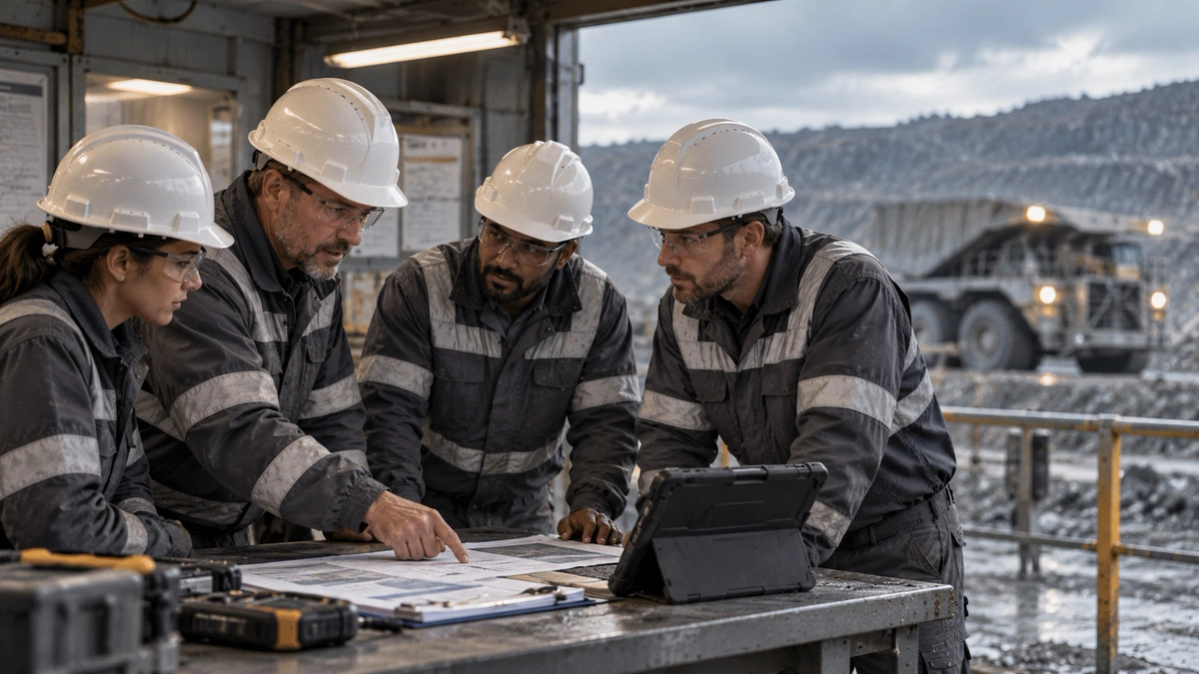
A mining shift does not end when one crew leaves the site.
The next shift begins with the information transferred from the previous team.
A missed maintenance update, unclear equipment status, or incomplete production summary can create delays, safety risks, and unnecessary decision-making gaps.
In a continuous mining environment, shift handover is not just a reporting activity. It is an operational control process that ensures the incoming team understands:
- What happened during the previous shift
- What issues remain open
- What needs immediate attention
- What priorities must continue
A structured mining shift handover checklist helps teams maintain continuity between crews and improve daily operational efficiency.
Key Takeaway
A mining shift handover checklist ensures critical information about production, equipment, safety, maintenance, and priorities is transferred between teams. A strong handover combines accurate reporting, face-to-face communication, and real-time operational visibility to reduce avoidable delays.
Why Mining Shift Handover Is More Than an End-of-Shift Report
An end-of-shift report records what happened.
A proper operational handover explains what happens next.
This difference matters.
A basic report may state:
"Truck 14 was unavailable."
A useful handover provides context:
"Truck 14 unavailable since 04:20 due to hydraulic leak. Maintenance inspection completed. Parts expected at 09:00. Loads reassigned to Shovel 3 fleet. Maintenance lead responsible for restoration."
The second example gives the incoming team enough information to make decisions immediately.
A good handover transfers operational knowledge, not just information.
Mining Shift Handover Checklist
The following checklist covers the critical information teams should transfer during every shift change.
Checklist Item | What to Record | Owner |
|---|---|---|
Production status | Planned vs actual tonnes, completed activities, remaining targets | Production Supervisor |
Equipment status | Operating equipment, breakdowns, repairs, expected return time | Operations + Maintenance |
Active delays | Cause, duration, impact, corrective action | Area Owner |
Safety information | Risks, incidents, permits, isolations, exclusion zones | Shift Supervisor |
Site conditions | Ground conditions, weather impact, access restrictions | Operations Team |
Dispatch status | Current equipment allocation and priorities | Dispatch Team |
Crusher and stockpile status | Capacity limits, material availability, processing constraints | Plant Team |
Next shift priorities | Critical actions and pending decisions | Incoming Supervisor |
This checklist helps ensure the incoming team receives the operational context required to continue work safely and efficiently.
Essential Safety Information During Shift Change
Safety information should always be a priority during mine shift handovers.
The incoming team should understand:
- Active permits to work
- Open isolations and lockout/tagout status
- Restricted areas
- Upcoming blasts and exclusion zones
- Ground stability concerns
- Ventilation conditions in underground operations
- Weather-related risks in open-pit operations
For example, an upcoming blast area or an active equipment isolation that is not communicated properly can create serious operational and safety consequences.
Safety information should never depend only on written notes. It should be verbally confirmed during handover.
How to Run an Effective Mine Shift Change Process
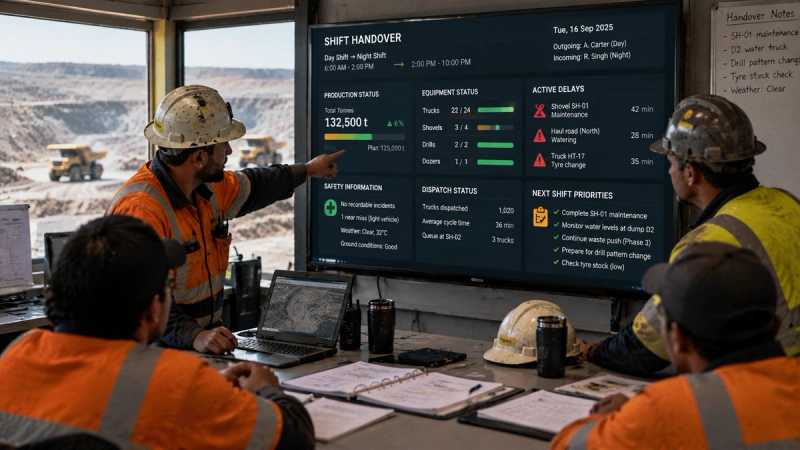
A strong mine shift change process depends on how the handover happens, not only what is recorded.
Conduct Face-to-Face Handover
Written reports provide records, but direct communication allows teams to discuss priorities, risks, and unclear situations.
Use Two-Way Confirmation
The incoming supervisor should confirm key points by repeating critical information:
- Current equipment risks
- Pending actions
- Safety restrictions
- Production priorities
This reduces misunderstanding.
Assign Ownership Clearly
Every unresolved issue should have:
- A responsible person
- Expected action
- Follow-up timeline
An issue without ownership is likely to continue into the next shift.
How Shift Handover Supports Production Performance
Shift changes can create hidden productivity losses.
Slow restarts, unclear equipment priorities, and missing information can reduce operating time before the new crew reaches full production.
These losses often appear as:
- Increased standby time
- Delayed equipment deployment
- Longer decision cycles
- Missed production targets
Using standardized operational KPIs helps teams understand where time is being lost.
The GMG Time Usage Model provides a framework for understanding equipment time categories and identifying operational losses.
Connecting Shift Handover With Short Interval Control
Short Interval Control (SIC) manages operational issues while the shift is active.
Shift handover ensures those issues continue to be managed after the crew changes.
For example:
During a shift, SIC may identify that truck utilization has dropped because of loading delays.
The handover should communicate:
- What caused the delay
- What corrective action was taken
- What the next shift should monitor
This creates continuity instead of restarting the analysis every shift.
Learn more about Short Interval Control in mining.
How Digital Tools Improve Shift Handover Accuracy
Many mining operations still depend on spreadsheets, paper reports, and verbal updates.
These methods can create information gaps:
- Different versions of data
- Delayed reporting
- Missing operational context
- Manual summary errors
Modern operational intelligence platforms help connect:
- Production data
- Equipment events
- Maintenance updates
- Delay information
This allows teams to create more accurate handovers using current operational information.
For example, an incoming supervisor can quickly understand:
- Which equipment is unavailable
- Where production is behind plan
- Which issues require immediate action
Real-time operational intelligence helps improve visibility across mining operations.
Learn more about real-time operational intelligence in mining.
How AI Can Improve Mining Shift Handovers
One of the most practical applications of AI in mining operations is automated handover preparation.
Instead of manually collecting information from multiple systems, AI can summarize:
- Production performance
- Equipment events
- Delay reasons
- Maintenance activities
- Outstanding actions
For example, an AI-generated handover summary could highlight:
"Production finished 8% below plan due to crusher delay and increased truck queue time. Truck 8 returned to operation after maintenance. Monitor Shovel 2 availability during next shift."
This helps supervisors spend less time preparing reports and more time managing operations.
Building a Reliable Shift Handover System
A reliable mining shift handover process depends on three principles:
Complete information:Teams need accurate production, equipment, and safety updates.
Clear ownership:Every open issue needs responsibility and follow-up.
Operational visibility:Teams need current information, not only historical reports.
A strong handover process helps mining companies reduce delays, improve safety communication, and maintain production continuity.
HonestDig helps mining teams connect operational data with better decisions through intelligent solutions designed for modern mining operations.
Frequently Asked Questions
What should be included in a mining shift handover checklist?
A mining shift handover checklist should include production status, equipment condition, safety information, active delays, maintenance updates, site conditions, dispatch priorities, and next-shift actions.
What is the difference between a shift handover and an end-of-shift report?
An end-of-shift report records completed activities and performance results. A shift handover provides context, unresolved issues, and priorities required by the incoming team.
Why is face-to-face communication important during mine shift changes?
Face-to-face communication allows supervisors to clarify risks, confirm priorities, and ensure important operational information is understood correctly.
How can digital tools improve mining shift handovers?
Digital tools connect production, equipment, maintenance, and delay data to create more accurate and timely handover information.
How does AI support mining shift handovers?
AI can automatically analyze operational data and create summaries of production performance, equipment issues, delays, and pending actions for incoming teams.