Short Interval Control in Mining: Closing the Plan vs Actual Gap
Learn how Short Interval Control (SIC) in mining helps teams monitor shift performance, reduce production variance, and improve operational decisions.

How to Close the Plan vs Actual Gap Every Shift
A mining shift can lose production within the first few hours.
At 10:00 AM, a shovel may be producing below target. Trucks may spend more time waiting at the loading point. A maintenance issue may reduce equipment availability. By the end of the shift, the operation may miss its production goal, but identifying the exact cause becomes difficult.
The challenge is not always the mine plan. The challenge is knowing when actual performance starts moving away from the plan and taking action before the gap becomes difficult to recover.
Short Interval Control (SIC) in mining helps operations teams continuously compare planned activities with actual performance, identify production gaps, and coordinate corrective actions while the shift is still active.
Unlike traditional end-of-shift reporting, SIC creates a continuous connection between planning, execution, and operational decisions.
Key Takeaway
Short Interval Control in mining is a shift management process that compares planned production against actual performance at regular intervals. By combining operational data, team reviews, and clear action ownership, SIC helps reduce mine production variance and improve shift-level decision-making.
Why Mining Operations Lose Control Between the Plan and the Shift
Every mining operation begins with a detailed production plan.
The plan defines:
- Expected tonnes moved
- Equipment allocation
- Mining sequence
- Shift targets
- Expected cycle times
- Workforce requirements
However, mining environments change constantly.
A haul road condition can increase truck cycle time. A loading unit can experience downtime. A delay in one activity can impact multiple connected operations.
These small disruptions create the plan vs actual mining gap.
Traditional reporting methods often identify these issues after the shift ends. Teams understand what happened, but the opportunity to recover lost production has already reduced.
Short Interval Control changes this by making performance monitoring part of the shift itself.
What Is Short Interval Control (SIC) in Mining?
Short Interval Control (SIC) is a structured operating process where mining teams review performance at short intervals during a shift.
Depending on the operation, SIC reviews are commonly conducted hourly or every two hours.
The process usually involves:
- Shift supervisors
- Dispatch teams
- Control room operators
- Production managers
- Equipment coordinators
The purpose is simple:
Understand what changed, identify the impact, assign ownership, and decide the next action.
SIC is not just a reporting dashboard. It is a management routine that connects people, processes, and operational information.
How Short Interval Control Works During a Real Mining Shift
Consider an open-pit mining operation with a shift production target of 10,000 tonnes.
After three hours, the operation is 15% behind plan.
A Short Interval Control review identifies:
- Shovel 2 was unavailable for 40 minutes due to a mechanical issue
- Truck queue time increased at the loading area
- Three trucks were operating below expected utilization
Instead of waiting until the end of the shift, the team takes corrective action:
- Three trucks are reassigned to another loading area
- Dispatch priorities are adjusted
- Maintenance escalation is tracked separately
By responding during the shift, the team reduces the production gap instead of simply recording the missed target.
This is the core value of SIC: moving from reporting problems to actively managing performance.
The Short Interval Control KPIs Mining Teams Should Track
Effective SIC depends on monitoring operational signals that directly influence production.
Short Interval Control KPI | What Teams Should Monitor |
|---|---|
Tonnes per hour vs plan | Whether production is tracking against shift targets |
Truck cycle time | Whether hauling efficiency is declining |
Truck queue time at shovel | Whether loading areas are creating bottlenecks |
Shovel utilization | Whether loading equipment is being used effectively |
Payload compliance | Whether trucks are carrying optimal loads |
Equipment availability | Whether asset issues are affecting production |
Delay codes | Whether recurring operational problems are increasing |
These metrics help teams understand not only that production is behind, but why it is behind.
For example, equipment availability issues can quickly affect output. Understanding the cost of unplanned downtime in mining helps teams prioritize faster response to asset-related problems.
Why Short Interval Control Programs Fail in Mining
Many SIC programs struggle because they focus heavily on data collection but not enough on operational discipline.
Data Arrives Too Late
If production information reaches teams hours after an issue occurs, the ability to recover performance decreases.
Too Many Metrics Create Confusion
Tracking every available indicator can make it difficult to identify which problems require immediate action.
Actions Lack Ownership
A problem identified during an SIC review needs a clear owner and follow-up action.
Reviews Become Status Meetings
SIC should create decisions, not just discussions. Teams need short reviews focused on identifying issues and assigning actions.
A successful SIC process combines accurate data with a strong operating routine.
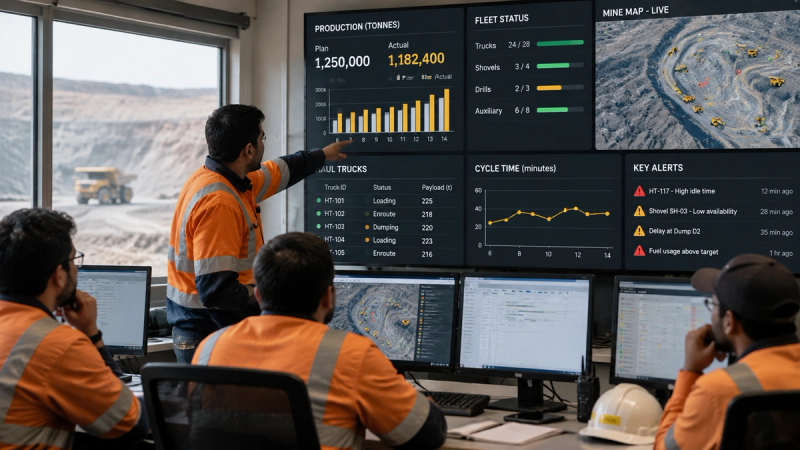
How Real-Time Operational Intelligence Strengthens SIC
Modern mining operations generate data from multiple systems:
- Fleet management platforms
- Equipment monitoring systems
- Maintenance systems
- Production tracking tools
The challenge is turning this information into a clear operational view.
Real-time operational intelligence helps teams understand current conditions instead of relying only on historical reports.
It can help identify:
- Declining production rates
- Increasing cycle times
- Equipment performance issues
- Repeated delay patterns
Mining teams can improve their visibility with real-time operational intelligence in mining.
How AI Can Make Short Interval Control More Predictive
AI can strengthen SIC by helping teams identify potential production risks earlier.
Instead of only showing current performance, AI-powered systems can analyze:
- Current production rates
- Historical delay patterns
- Equipment behavior
- Cycle time changes
For example, AI can help identify that a shift is likely to miss its production target by hour four based on current operating conditions.
This gives teams more time to adjust resources, change priorities, or address operational constraints.
AI is becoming increasingly relevant in open-pit mining operations, where multiple equipment movements and production activities must work together.
Closing the Plan vs Actual Gap Every Shift
Mining plans define what should happen. Execution determines what actually happens.
The difference between the two is where production opportunities are often lost.
Short Interval Control gives mining teams a structured approach to monitor performance, understand mine production variance, and respond while operations are still active.
By combining operational discipline with real-time visibility, mining companies can improve shift performance, reduce avoidable delays, and create more predictable production outcomes.
HonestDig helps mining operations connect operational data with faster decisions through intelligent solutions designed for modern mining environments.
Learn how Guaranteed Production Throughput can help improve operational control and production consistency.
Frequently Asked Questions
What is Short Interval Control (SIC) in mining?
Short Interval Control (SIC) in mining is a process where teams review planned versus actual performance at regular intervals during a shift. It helps identify production gaps, assign actions, and improve operational response.
How often should Short Interval Control meetings happen?
SIC reviews are commonly conducted hourly or every two hours depending on the operation. The goal is to create enough visibility for teams to respond without disrupting production activities.
What are the key Short Interval Control KPIs?
Important SIC KPIs include tonnes per hour versus plan, equipment availability, truck cycle time, shovel utilization, queue time, payload compliance, and delay reasons.
How does SIC improve mine production performance?
SIC improves performance by helping teams identify operational issues during the shift instead of waiting for end-of-shift reporting. Faster response can reduce the impact of production delays.
Can AI improve Short Interval Control in mining?
Yes. AI can support SIC by analyzing operational data, identifying patterns, predicting possible production shortfalls, and helping teams prioritize operational actions.