Digital Twins in Mining: Turning Data into Real-Time Decisions
Understand how digital twins in mining convert live operational data into real-time decisions, improving throughput, safety, and predictive control.
Why Digital Twins in Mining Are Becoming Critical
Mining operations are not short on data.
Sensors, fleet systems, and operational tools generate continuous streams of information. The real issue is that this data is still not connected to decisions in real time. Most operations still rely on delayed reporting cycles where insights come after the opportunity to act has already passed.
Digital twins close this gap.
They create a live, continuously updated representation of the mine where data is processed and applied instantly. Instead of waiting for reports, teams can respond as conditions change.
This shift moves operations from observation to control, and it builds directly on real-time operational intelligence in mining.
What a Digital Twin in Mining Actually Means
A digital twin is often confused with a dashboard or a 3D model.
In practice, it is a live operational layer that connects physical mining activity with real-time data and decision logic. It integrates multiple streams into one system, including:
- equipment performance and telemetry
- haulage movement and dispatch data
- environmental and safety conditions
- workforce activity and site logistics
The key difference is not visualization.
It is synchronization.
Instead of showing what already happened, the system reflects what is happening now and what is likely to happen next. That is what enables faster and more confident decisions.
From Static Models to Intelligent Systems
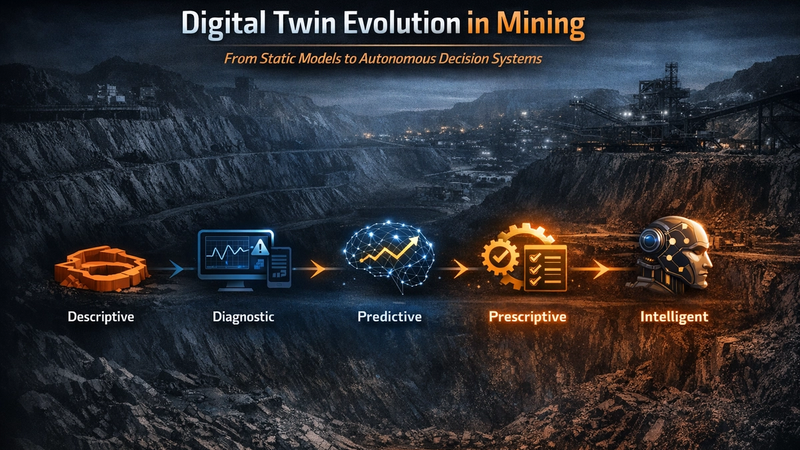
Digital twins in mining have evolved in stages, and most operations are still early in that journey.
Initially, systems focused on visualization, helping teams understand layouts and site conditions. As more data became available, they started identifying issues and diagnosing problems. The real shift happens when systems begin predicting outcomes and recommending actions.
The most advanced stage goes further, where the system starts adjusting operations automatically based on changing inputs.
This progression typically follows:
Stage | Description |
|---|---|
Descriptive | Visual representation of the mine and site conditions |
Diagnostic | Identification of issues using live data |
Predictive | Forecasting failures and performance trends |
Prescriptive | Recommending operational changes based on data insights |
Intelligent | Automated decision-making and real-time operational control |
Moving into the last two stages is where digital twins start delivering real operational value.
How Digital Twins Turn Data into Decisions
The value of a digital twin becomes clear in how it changes everyday decisions on site.
One of the most immediate benefits is faster identification of bottlenecks. Mining operations are tightly linked systems, and a delay in one area quickly impacts the rest of the chain. Instead of waiting for end-of-shift analysis, teams can see where the slowdown is forming and act immediately.
This is where improvements in AI-driven dispatch improving mining throughput start to compound.
Digital twins also allow teams to test decisions before implementing them. For example, changes in haul routes, fleet allocation, or shift planning can be simulated inside the system. This reduces risk and prevents unnecessary disruption in live operations.
Maintenance is another area where the shift is clear. Instead of reacting to breakdowns, digital twins identify early warning signals through patterns in equipment data. Subtle deviations in temperature, vibration, or performance can indicate failure before it occurs, addressing the inefficiencies discussed in the hidden costs of reactive maintenance in mining.
Across all of this, the biggest advantage is that decisions are no longer isolated. The system considers the full operational context before recommending or triggering actions.
The Technology Behind Digital Twins in Mining
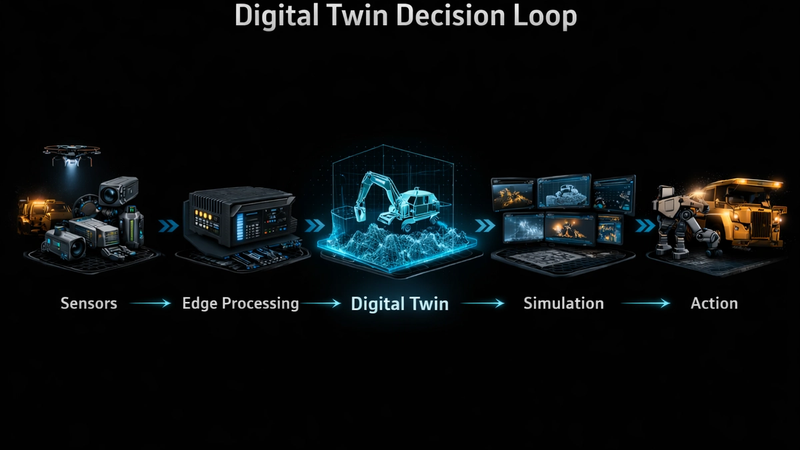
A digital twin is only as effective as the system supporting it.
Layer | Role |
|---|---|
Data Layer | Continuous inputs from equipment, environment, and workforce |
Connectivity Layer | Reliable data transfer across the mining site |
Processing Layer | Edge and cloud systems enabling real-time analysis |
Application Layer | Dashboards, simulations, and decision-making tools |
If this structure is fragmented, the digital twin becomes another reporting system instead of a decision system.
Where Digital Twins Deliver the Most Impact
The impact of digital twins is most visible in areas where delays and variability directly affect output.
For example:
- Haulage operations see reduced idle time and better fleet utilization
- Production becomes more consistent across shifts
- Maintenance planning shifts from reactive to predictive
- Safety improves through early detection of risk conditions
These outcomes align closely with guaranteed production throughput and predictive site resilience, where the focus is on stability, efficiency, and control.
Why Many Digital Twin Initiatives Fall Short
Despite the potential, many implementations do not deliver results.
The issue is usually not the concept but the execution.
Common challenges include:
- disconnected or siloed data sources
- weak integration with existing systems
- poor data quality
- lack of alignment with operational workflows
When digital twins are treated as visualization tools rather than decision systems, they fail to create impact.
For them to work, they must be directly embedded into how decisions are made on site.
From Digital Twin to Real-Time Mining Control
The real goal is not to build a digital twin. It is to create a system where decisions happen faster, with better context and less uncertainty.
When digital twins are connected to operational workflows, they start influencing dispatch adjustments, workforce coordination, production planning, and risk response. This is where they begin to overlap with systems like autonomous workforce governance, forming the foundation of a more connected mining operation.
This is where they begin to overlap with systems like autonomous workforce governance, forming the foundation of a more connected mining operation.
What This Means for Mining Operations
Mining operations are becoming more complex, with more variables and tighter margins.
Relying on delayed insights or manual interpretation is no longer sustainable at scale.
Digital twins provide a way to manage that complexity by connecting data directly to decisions. They reduce delays, improve predictability, and help operations respond faster to change.
For operations already investing in systems like real-time operational intelligence in mining or focusing on guaranteed production throughput, digital twins are not a separate initiative. They are a natural next step toward building a fully connected, decision-ready mining operation.
Frequently Asked Questions
1. What is a digital twin in mining?
A digital twin is a live virtual model of mining operations that updates continuously using real-time data.
2. How is it different from traditional mining software?
Traditional systems focus on past data, while digital twins support real-time decisions.
3. Can digital twins improve productivity?
Yes. They help reduce delays, optimize dispatch, and improve overall efficiency.
4. Do digital twins require constant connectivity?
They use a mix of edge and cloud systems, allowing operations to continue even with limited connectivity.
5. What is the biggest advantage of digital twins?
They enable faster, more accurate decisions across the entire operation.