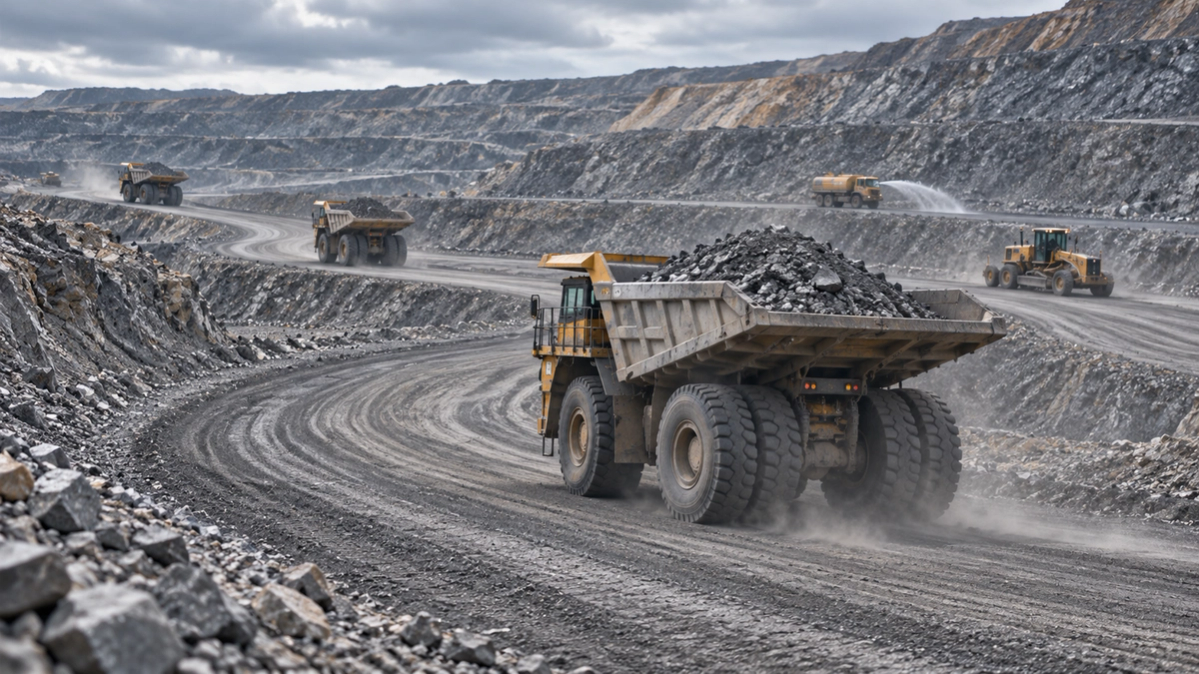
A haul truck follows the same route every shift, carrying similar payloads. Yet travel times increase, fuel costs rise, and tyres wear faster.
The problem may not be the truck. It may be the road.
Haul road rolling resistance affects the energy required to move mining equipment. As road surfaces deteriorate, trucks work harder, travel more slowly, and experience additional mechanical stress.
For mining operations, the challenge is identifying which road sections create the greatest production and operating losses.
Key Takeaway
Higher haul road rolling resistance increases truck cycle times, fuel demand, and tyre stress. Monitoring road conditions alongside fleet performance helps mines identify costly haulage sections, prioritize maintenance, and improve production efficiency.
What Is Haul Road Rolling Resistance?
Rolling resistance is the force required to move a vehicle across a road surface. It increases when tyres deform, penetrate loose material, or travel over uneven ground.
According to Caterpillar's rolling resistance guidance, 2% is a commonly used general estimation baseline, not a universal value for maintained roads.
A useful rule is that 1% rolling resistance creates resistance equivalent to a 1% uphill grade, approximately 10 kg-force per tonne of gross vehicle weight.
Effective grade (%) = Road grade (%) + Rolling resistance (%)
A truck climbing an 8% grade with 2% rolling resistance encounters approximately 10% effective grade. If resistance rises to 5%, effective grade reaches 13%.
This matters particularly on loaded uphill hauls, where increased resistance can sharply reduce available travel speed.
Rolling Resistance by Haul Road Condition
Caterpillar provides indicative rolling resistance estimates for radial-tyred equipment.
Road Surface Condition | Rolling Resistance |
|---|---|
Hard, smooth surface without penetration | 1.2% |
Firm, maintained surface with slight flexing | 2.5% |
Rutted dirt road, approximately 25 mm penetration | 4% |
Soft, rutted road, approximately 100 mm penetration | 8% |
Very soft, muddy surface, approximately 300 mm penetration | 20% |
How Rolling Resistance Affects Cycle Time and Production
Consider an illustrative mine operating four haul trucks, each carrying 100 tonnes.
A normal 20-minute cycle includes 12 minutes of travel. Deteriorating road conditions add three minutes, increasing cycle time to 23 minutes.
Over eight continuous operating hours:
- At 20 minutes: 9,600 tonnes of theoretical haulage.
- At 23 minutes: approximately 8,348 tonnes.
- Potential difference: approximately 1,252 tonnes.
This represents a 13% reduction in theoretical throughput, assuming unchanged payloads, operating time, and other conditions.
Fewer completed cycles can also disrupt shovel-truck coordination, creating additional waiting and allocation problems.
Explore haul truck cycle time calculations and AI-driven mining dispatch.
Impact on Fuel Consumption and Tyre Life
Fuel Consumption
Higher resistance increases traction demand, particularly during loaded uphill travel.
Even unchanged hourly fuel consumption can conceal worsening efficiency.
For example, if a fleet burns 120 litres per hour:
- At 1,200 tonnes/hour: 0.10 litres per tonne.
- At 1,043 tonnes/hour: approximately 0.115 litres per tonne.
Fuel per tonne increases by approximately 15%, despite unchanged hourly consumption. These figures are illustrative.
Tyre Life
Poor surfaces increase tyre flexing, heat generation, impact damage, and cut risks.
Tyre workload is commonly assessed using TKPH (tonne-kilometres per hour), which relates average tyre load to operating speed and heat limits. Michelin's tyre selection guidance explains this relationship.
Repeated cuts associated with particular road sections suggest surface hazards, while widespread wear may indicate inflation, loading, or operating issues.
Premature tyre removal increases replacement costs and equipment downtime, strengthening the business case for preventive road maintenance.
How Can Mines Measure Rolling Resistance?
Three approaches help identify high-resistance road sections.
1. Controlled field testing: Engineering teams can estimate resistance through approved instrumented testing, including coast-down methods where safe and technically appropriate.
2. Segment-level performance analysis: Compare loaded truck speeds, fuel consumption, payloads, and travel times across consistent road sections. Control for grade, equipment type, and traffic.
3. Road inspections: Check rutting, loose material, drainage, and surface deformation. After heavy rain or monsoon conditions, inspections become particularly important.
Soft or waterlogged surfaces also affect traction, braking, and vehicle control.
Prioritizing Road Maintenance With Connected Data
Consider a haul road section where loaded truck speeds decline over three weeks following heavy rainfall.
Fuel consumption per tonne rises, but payloads and queuing remain consistent. Equipment availability shows no significant deterioration.
This pattern suggests that road resistance deserves investigation.
Connected fleet and production data can help identify the affected segment, while a physical inspection confirms the condition. Maintenance teams can then schedule grading, drainage improvements, or compaction.
AIM by HonestDig focuses on connecting operational information for better decisions. Segment-level road performance analysis would depend on available GPS, fuel, and payload data and require technical validation.
Maintenance also involves trade-offs. Grading and watering consume resources, while excessive watering can soften road surfaces.
For example, an illustrative $900 maintenance intervention may be justified against $3,756 in potential production contribution at risk, calculated from 1,252 tonnes at $3 per tonne. Actual recovery and costs must be verified before making the investment decision.
Improve Haulage Performance With HonestDig
The objective is not simply faster trucks. It is identifying which haul road sections create the greatest operational losses and acting before those losses escalate.
AIM by HonestDig connects mining information to support more informed fleet, maintenance, and production decisions.
Explore Guaranteed Production Throughput to understand how connected operational intelligence supports mining performance.
Schedule a Demo or Contact HonestDig to discuss your haulage performance challenges.
Frequently Asked Questions
What is haul road rolling resistance?
It is the resistance a truck encounters while moving across a road surface, influenced by tyre deformation, ground conditions, and vehicle weight.
How does rolling resistance affect cycle time?
Higher resistance increases the effort required to travel, potentially reducing truck speed and extending haulage cycles.
What is a normal rolling resistance value?
A 2% baseline is commonly used for general estimates, but actual values depend on surface and tyre conditions.
How can mines measure rolling resistance?
Mines can use controlled field tests, GPS-based segment analysis, fuel and speed comparisons, and physical road inspections.
Does poor haul road maintenance affect tyres?
Yes. Rutting, loose rocks, deformation, and poor drainage contribute to tyre damage, heat buildup, and premature removal.