Mine Planning Software vs Mine Operations Management Software
Compare mine planning and operations management software, including their users, functions, data and roles across planning and execution.
Mine Planning Software vs Mine Operations Management Software
Mine planning software defines where, when and how mining should happen. Operations management software helps the site control what is happening now.
A mine planning system cannot decide how to recover the shift when the primary loader fails at 10:20.
A mine operations management system cannot redesign the pit, optimise the life-of-mine sequence or produce a defensible reserve schedule.
The two systems solve different problems. Confusion starts because both may include scheduling, production targets and equipment information.
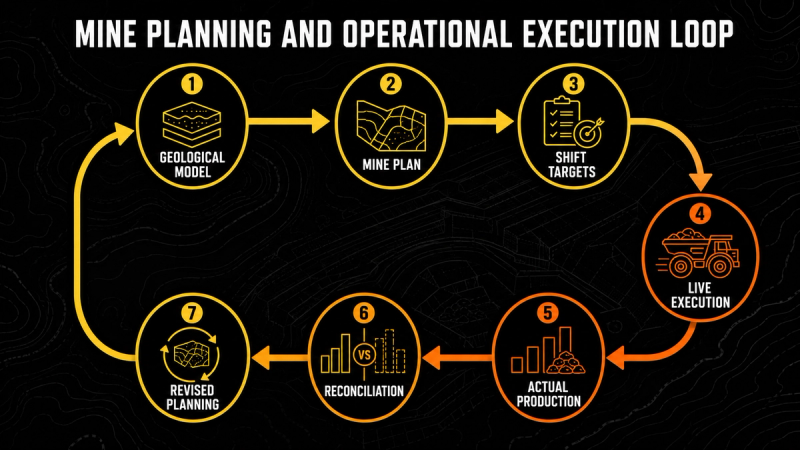
The practical difference is time and purpose. Mine planning software builds the plan. Mine operations management software controls execution and returns actual performance data to the planning process.
Key Takeaway
Mine planning software supports geological modelling, mine design, optimisation and scheduling across strategic, tactical and short-term horizons. Mine operations management software connects live equipment, workforce and production data so teams can respond to delays and control execution during the shift. Most mines need both systems connected through a plan, execute, measure and replan cycle.
Mine Planning vs Operations Management Software at a Glance
Area | Mine planning software | Mine operations management software |
|---|---|---|
Primary purpose | Build a technically and economically viable mine plan | Control execution against the approved plan |
Main time horizon | Life of mine to daily or weekly planning | Current shift and near-term operations |
Core data | Geology, block models, reserves, designs and constraints | Equipment, production, delays, workforce and task status |
Typical users | Mine planners, engineers, geologists and technical services | Dispatchers, supervisors, maintenance and operations teams |
Main output | Designs, schedules, extraction sequences and targets | Assignments, alerts, actual performance and response actions |
Main question | What should the mine do? | What is happening, and what should change now? |
Update pattern | Planning cycles and approved revisions | Continuous or near-real-time updates |
Business value | Protect deposit value and create an achievable plan | Improve execution, response speed and plan attainment |
The distinction is clear in theory. In practice, some planning platforms include operational scheduling, while some operations platforms include short-interval planning.
Evaluate the job each system performs rather than relying only on the product category.
What Mine Planning Software Does
Mine planning software helps technical teams determine how a mineral deposit should be developed and extracted.
Its work begins with geological and resource information. The software helps convert that information into pit designs, underground layouts, production schedules and economic scenarios.
Typical capabilities include:
- Geological and block modelling
- Pit or underground mine design
- Strategic optimisation
- Pushback and extraction sequencing
- Short, medium and long-term scheduling
- Haulage, blending and processing constraints
- Reserve and production calculations
Maptek describes Vulcan as a 3D modelling, design and scheduling environment covering block modelling, grade control, drill and blast, geotechnical analysis and optimisation. Maptek Vulcan demonstrates the breadth of work covered by modern planning platforms.
Hexagon’s long-term MinePlan tools use detailed mining constraints to optimise schedules around life-of-mine value. Hexagon MinePlan provides another example of planning software focused on strategic scheduling and NPV.
The planning system creates the intended sequence and production target. It does not automatically know whether the current operator arrived late, the shovel lost hydraulic pressure or the haul road became congested during the shift.
What Mine Operations Management Software Does
Mining operations management software begins where the approved plan meets site conditions.
It connects operational data from equipment, dispatch, maintenance, workforce and production systems. The platform compares planned activity with what is actually happening.
Its role is to help teams detect deviations and coordinate a response while the shift is still active.
Typical capabilities include real-time equipment status, task progress, delay monitoring, workforce readiness, production variance, alerts and action tracking.
ABB describes its mining Operations Management System as a platform that connects workforce and equipment in real time, supports rapid replanning and links high-level planning with operational control. ABB’s mining operations management system illustrates how execution software responds to live production conditions.
A fleet management system may form part of this environment, but the categories are not identical. Fleet software focuses primarily on mobile equipment and haulage. Operations management extends control across production, maintenance, workforce and related site constraints.
The difference is examined further in this comparison of fleet management software and operations intelligence.
Where Planning Ends and Execution Begins
Consider a mine with a shift target of 50,000 tonnes and a defined blend required at the crusher.
The short-term plan specifies the mining areas, expected grades, loading units, truck requirements and destination for each material type.
Two hours into the shift, actual material quality from one source begins tracking below the planned grade. If the same haulage pattern continues, the crusher feed will move outside the preferred blend.
The planning software contains the approved extraction sequence, grade assumptions and destination rules. The operations management system provides the live context needed to manage the deviation.
It can help the operations team evaluate available responses:
- Redirect selected trucks to an alternative source
- Change the destination of lower-grade material
- Adjust the active blend between mining areas
- Prioritise updated sampling or grade confirmation
- Recalculate the expected shift outcome
At the end of the shift, actual tonnes, grades, source locations and destinations should return to the planning and reconciliation process.
This closes the gap between what the mine intended to extract and what it actually delivered.
Why Short-Term Scheduling Creates Confusion
Mine planning software can create detailed daily, weekly and monthly schedules. Operations management software may also create or adjust shift-level assignments.
This overlap does not make the systems interchangeable.
Planning software schedules work using geological, engineering and production constraints. Operations management software adjusts execution using live site conditions.
For example, planning software may determine that a specific block should supply the crusher during the day shift. Operations software helps manage truck assignments and production response when actual grade, equipment availability or plant demand moves away from the assumptions used in that schedule.
Planning defines the preferred sequence. Operations management protects that sequence or manages the deviation.
The Data Each System Should Exchange
Planning sends to operations | Operations returns to planning |
|---|---|
Mining areas and sequence | Actual areas mined |
Tonnes and grade targets | Actual tonnes and material movement |
Equipment assumptions | Actual equipment availability |
Destination and blending rules | Actual destinations and blend outcomes |
Shift or period targets | Delays and plan variance |
Development priorities | Completed and incomplete work |
This connection supports more accurate planned versus actual mine production analysis.
It also improves future planning assumptions. If the plan repeatedly assumes higher truck availability or shorter cycle times than the mine achieves, the issue is not only execution. The planning inputs may need correction.
Reconciliation Connects Planning With Reality
Reconciliation is the control point between planned and actual performance.
It should establish what material was mined, where it came from, where it went and how actual tonnes and grades compared with the model and schedule.
Weak reconciliation allows errors to persist. A mine may repeatedly miss its plan without knowing whether the cause sits in geology, equipment assumptions, operational execution or data quality.
The right mine reconciliation software should connect planning, survey, production and processing information without hiding the source of each figure.
Operations management strengthens this process by improving the quality and timing of actual execution data.
Do You Need Both Systems?
Most operating mines need both capabilities.
Mine planning software protects long-term value and converts the resource into an achievable extraction strategy. Operations management software helps the site execute that strategy under changing daily conditions.
A mine may need stronger operations management if it has good plans but regularly discovers deviations after the shift has ended.
Common signs include:
- Repeated plan-versus-actual gaps without clear causes
- Manual shift reports assembled from several systems
- Delays identified after production has already been lost
- Dispatch, maintenance and production teams using different data
- Planning assumptions that are not updated with actual performance
A mine may need stronger planning capability if operations teams receive unrealistic targets, unstable extraction sequences or schedules that ignore practical equipment and processing constraints.
Buying one category to solve a problem belonging to the other will create another reporting layer without fixing the underlying gap.
What to Evaluate Before Selecting Software
Start by identifying the decision the mine cannot make reliably today.
If the problem involves pit design, geological modelling, reserves or long-term optimisation, focus on mine planning software.
If the problem involves live production visibility, delay response, workforce coordination or shift execution, focus on mining operations management software.
When comparing platforms, ask:
- Which decisions does the system support?
- What planning horizon does it manage?
- Which system owns each critical data point?
- Can approved plans move into execution without manual rebuilding?
- Can actual performance return to planning and reconciliation?
- Can the system integrate with existing fleet, ERP and maintenance platforms?
The purpose of mining systems integration is not to move every function into one product. It is to create a reliable flow between systems with different responsibilities.
How AIM Connects the Plan With Mine Execution
AIM by HonestDig operates as an intelligence and control layer across live mining operations.
Approved shift targets, mining areas, equipment assumptions and destination rules can be connected with live production, fleet, workforce and maintenance data.
During execution, AIM compares planned and actual performance, identifies emerging deviations and shows their effect on the shift target. Teams can coordinate a response using the same operational context.
Actual tonnes, delays, equipment status and task completion can then feed reconciliation and future planning. This mirrors the same bidirectional data loop that strong mine planning and execution depend on.
See how AIM supports production throughput across connected mining operations.
Frequently Asked Questions
What is the difference between mine planning and mine operations management software?
Mine planning software designs and schedules how the deposit should be mined. Mine operations management software controls live execution and helps teams respond to deviations during the shift.
Can mine planning software track real-time production?
Some platforms include operational modules or receive actual production data. Their main role remains planning, design and scheduling rather than cross-functional real-time operational control.
Is fleet management software the same as mine operations management software?
No. Fleet management focuses mainly on equipment movement, dispatch and haulage. Operations management can connect fleet activity with production, maintenance, workforce and site-wide constraints.
Why should planning and operations software be integrated?
Integration allows approved targets and schedules to move into execution while returning actual production, delays and equipment performance to planning and reconciliation.
Can mine planning and operations software be implemented in phases?
Yes. A mine can begin with the capability addressing its most urgent decision gap, then connect the second system through controlled data integration. The implementation sequence should preserve clear ownership of planning and operational data.
Which software should a mine implement first?
Start with the most important decision gap. Mines without reliable designs or schedules need planning capability. Mines with strong plans but weak shift execution need operations management. Many mines require both as connected systems.