Mining ESG Software Buyer’s Guide for Mine Operators
Stop rebuilding ESG reports from scattered mine data. Compare software features, integrations and controls for accurate, audit-ready reporting.
Mining ESG Software Buyer’s Guide
Understand which capabilities matter, who should participate in the buying process and how to select ESG software that connects sustainability reporting with mining operations.
The sustainability team is preparing the annual ESG report. Fuel consumption comes from one system. Production data comes from another. Contractor hours remain in spreadsheets. Water data arrives from individual sites in different formats.
When two figures conflict, nobody can immediately confirm which one is correct.
The team spends more time tracing data than analysing performance. By the time the report is complete, it describes what happened months ago. It cannot help the mine reduce fuel consumption, control waste or correct an operational problem today.
This is the real test of mining ESG software. It must do more than assemble disclosures. It should connect ESG data with the operational decisions that create the result.
Key Takeaway
Mining ESG software helps mining companies collect, validate, monitor and report environmental, social and governance data. The right platform should connect with fleet, fuel, maintenance, workforce and ERP systems, maintain a clear audit trail and support relevant reporting requirements. Its value depends on whether it helps the mine improve ESG performance at the source, not only produce an annual report.
What Is Mining ESG Software?
Mining ESG software is a digital platform that centralises sustainability data from mine sites, operational systems and business functions.
It can support emissions accounting, energy and water monitoring, workforce and safety data, waste management, community indicators, governance controls and sustainability disclosures.
Mining creates a more difficult ESG data environment than many other industries. Operations may span multiple sites, commodities, jurisdictions, contractors and equipment fleets. Data can originate from sensors, fuel systems, laboratory records, invoices, maintenance platforms and manual site reports.
A suitable mining ESG reporting platform must handle this operational complexity without removing the context behind each figure. It must also work across the different conditions found in open-pit mining and underground mining.
Why General ESG Software Can Fall Short in Mining
Many ESG platforms start with the reporting framework and work backwards to the required data fields. This may help organise disclosures, but it does not always explain how the reported outcome developed.
Consider diesel emissions. A reporting system can calculate emissions from fuel consumption. It may not show whether unnecessary consumption resulted from excessive idling, poor dispatch, long queues, route conditions or low equipment utilisation.
The same gap appears across other ESG areas. A safety dashboard may record an incident without connecting it to worker readiness or task allocation. An energy report may show increased consumption without identifying the production constraint that caused it.
This is where mining operations management software becomes relevant. Connecting operational and ESG data helps teams trace an outcome back to the activity that influenced it.
Mining companies need accurate disclosures, but they also need information that supports better site decisions.
Which ESG Requirements Should the Software Support?
The required frameworks depend on the company’s operating jurisdictions, investors, customers and reporting commitments.
For mining-specific impact reporting, GRI 14 Mining Sector 2024 provides a common set of disclosures for the industry. It is in effect for organisations reporting under GRI from 2026.
Companies may also report sustainability-related financial information using IFRS S1 and climate-related information using IFRS S2. These standards organise disclosures around governance, strategy, risk management, and metrics and targets, according to the IFRS Foundation.
Greenhouse gas calculations may need to align with the GHG Protocol Corporate Standard, including relevant Scope 1, Scope 2 and Scope 3 sources.
Do not select software because its website displays the largest collection of framework logos. Determine whether the platform can map reliable source data to the disclosures the company actually needs to produce.
Core Features to Evaluate in Mining ESG Software
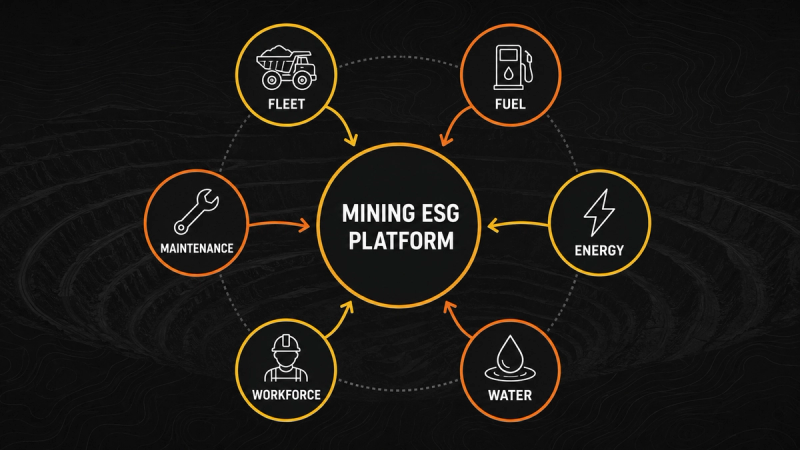
The strongest platforms combine reporting capability with data governance and operational visibility.
Capability | Why it matters | Question for the vendor |
|---|---|---|
Automated data collection | Reduces spreadsheet dependence and manual site submissions | Which mine systems and data sources can connect directly? |
Emissions and energy accounting | Supports consistent calculations across sites | Can users review calculation methods, factors and source data? |
Water, waste and land data | Covers material environmental impacts beyond carbon | Can the system manage site-level units, methods and boundaries? |
Workforce and safety data | Connects social reporting with shift activity | Can employee, contractor and competency data remain properly separated? |
Audit trails and approvals | Shows where a figure came from and who approved it | Does every adjustment preserve its source and change history? |
Framework mapping | Reduces duplicate work across reporting requirements | Can one metric support multiple disclosures without repeated entry? |
Target monitoring | Compares actual results against ESG commitments | Can users identify a developing variance before year-end? |
Operational analytics | Connects ESG outcomes with mine activity | Can the platform explain what caused a performance change? |
Multi-site reporting | Creates consistency across mines and jurisdictions | Can sites use local inputs while maintaining group definitions? |
Who Should Participate in the Buying Decision?
ESG software affects several departments. Building the right evaluation group helps prevent the company from selecting a reporting tool that cannot work with site conditions or existing systems.
Stakeholder | What they should assess | Question they must answer |
|---|---|---|
Sustainability team | Framework coverage, metrics and reporting workflows | Can we produce accurate disclosures without rebuilding the data manually? |
Site operations | Operational relevance and data availability | Does the platform reflect how the mine actually operates? |
Environmental team | Emissions, water, waste and land data | Are the calculations, units and site boundaries appropriate? |
Safety and HR | Workforce, contractor and safety information | Can the platform manage sensitive data and social indicators correctly? |
Finance | Reporting boundaries and reconciliation | Can ESG figures reconcile with financial and procurement records? |
IT and data teams | Integrations, security and data ownership | Can the platform connect securely with our existing systems? |
Internal audit | Evidence, approvals and change history | Can every material figure be traced back to its source? |
Executive leadership | Business value and risk reduction | Will the platform improve decisions as well as reporting? |
The sustainability team may lead the process, but site users should test the software before selection. They often create or validate the source information on which the entire ESG report depends.
How to Evaluate Mining ESG Software
Begin with the ESG metric that currently causes the most work or uncertainty. It could be diesel consumption, Scope 1 emissions, water withdrawal, contractor safety or site-level waste.
Then trace that metric back to its source.
1. Test the Complete Data Chain
Ask the vendor to demonstrate how the platform collects, validates, calculates, approves and reports one real metric.
Use a representative sample of company data. A polished dashboard built with clean vendor data does not prove that the software can handle inconsistent site records.
2. Examine Integration Depth
Clarify which connections operate automatically, how frequently they update and what happens when a source system changes.
A platform may advertise ERP integration while depending on periodic file uploads. For other metrics, direct connections to meters, workforce platforms, maintenance applications or site data stores may matter more.
3. Check Calculation Transparency
Users should be able to inspect activity data, units, emission factors, formulas, reporting boundaries and adjustments.
The platform must also preserve earlier values when a method or factor changes. Otherwise, the company may produce a number it cannot explain confidently during assurance or audit.
4. Test Site Usability
Site teams should be able to enter, review and approve data without creating another administrative burden.
Test the platform against connectivity limitations, local units, different reporting periods and varying levels of digital maturity across sites.
5. Measure Operational Value
Define what should improve during the pilot. The target might be shorter reporting cycles, fewer manual adjustments, faster evidence retrieval or earlier detection of abnormal resource consumption.
Do not measure success by the number of configured dashboards. Measure whether the company can produce more reliable information and act on it sooner.
Where AIM by HonestDig Fits
AIM connects fleet, workforce and site activity with sustainability outcomes. This gives mining teams a clearer view of which operational conditions contributed to changes in fuel, energy, safety or resource performance.
For example, reducing haul truck idle time can reduce unnecessary fuel consumption. Autonomous workforce governance can improve visibility across worker readiness, qualifications and shift execution. Predictive site resilience can help teams respond to disruptions before inefficient workarounds develop.
This approach gives sustainability teams stronger evidence while helping operational teams identify practical improvement opportunities.
Buy for Evidence and Better Decisions
Mining ESG software should reduce manual consolidation, create consistent definitions across sites and give teams confidence in the evidence behind each material figure.
The right platform should also help the mine identify performance gaps before they become year-end reporting problems.
To see how AIM can connect sustainability information with mine operations, schedule a demonstration with HonestDig.
Frequently Asked Questions
Can mining ESG software calculate Scope 1 emissions?
Yes. It can calculate Scope 1 emissions from diesel, gas and other directly controlled sources when the company configures its activity data, reporting boundaries and emission factors correctly.
Does ESG software replace environmental specialists?
No. Software manages data, calculations, approvals and reporting workflows. Qualified personnel must still interpret requirements, validate assumptions and assess site-specific impacts.
Can one platform support several ESG frameworks?
Many platforms can reuse a validated metric across several disclosures. Buyers should confirm whether the system maps the metric, methodology and supporting evidence correctly for each framework.
How does ESG software support external assurance?
It can provide reviewers with source records, calculation histories, approval logs and supporting evidence. Buyers should test how quickly the platform can reconstruct one reported figure during evaluation.
Can mining sustainability software work across several sites?
Yes, but the platform must handle local units, site boundaries, data owners and reporting schedules while maintaining consistent group-level definitions.
How should a mine choose a metric for the software pilot?
Select a material metric with known data or reconciliation problems. It should be important enough to test business value but narrow enough to trace from its original source to the final disclosure.
What is the difference between ESG reporting and ESG data management?
ESG reporting produces disclosures for stakeholders. ESG data management governs how the company collects, validates, calculates, approves and preserves the information behind those disclosures.