Mining Fleet Management Software: Open-Pit & Underground
Compare mining fleet management software for open-pit and underground mines. Evaluate dispatch, tracking, integration, maintenance, safety, and connectivity.
A Buyer’s Guide for Open-Pit and Underground Mines
Mining fleet management software should do more than display asset locations. It should help mine teams make faster decisions about dispatch, payload, maintenance, safety, and production execution.
Open-pit and underground mines rely on different positioning, connectivity, and traffic-control architectures. A platform that performs well across a connected surface haul network may not deliver dependable visibility below ground.
The buying process must therefore begin with the operating environment, not the vendor feature list.
Define the Mine Before Comparing Vendors
Before issuing an RFP, document:
- Fleet size, equipment classes, and OEM mix
- Surface, underground, or combined operating scope
- Communications and positioning infrastructure
- Systems requiring integration
- Decisions the platform must improve
For a mixed fleet, identify the required data for each asset class, including location, equipment state, engine hours, payload, fuel use, fault information, and operator identity.
Vendors should demonstrate how those fields are acquired, processed, and standardized across different equipment manufacturers.
Open-Pit and Underground FMS Requirements
Evaluation Area | Open-Pit Mine | Underground Mine |
|---|---|---|
Positioning | GNSS, GPS, and geofencing | RFID, BLE, Wi-Fi, radar, or other underground positioning |
Dispatch | Truck-to-shovel allocation and route optimization | Task allocation, traffic sequencing, and passing-bay control |
Production | Payload, queues, and cycle-time analysis | LHD cycles, development activity, location, and task progress |
Connectivity | LTE, private cellular, radio, or Wi-Fi | Mesh networks, Wi-Fi, leaky feeder, or local communications |
Safety | Speed, fatigue, geofence, and collision controls | Personnel tracking, proximity detection, and restricted routes |
For open-pit operations, mining dispatch software should support Short-Interval Control, or SIC.
Dispatchers need to respond to shovel availability, queue formation, payload variance, road conditions, and material priorities. Useful measures include cycle time, asset utilization, payload compliance, TKPH, and Overall Equipment Effectiveness where OEE is appropriate.
Underground mining fleet management software must work without depending on satellite positioning. It also needs spatial context for levels, declines, stopes, drawpoints, and restricted routes.
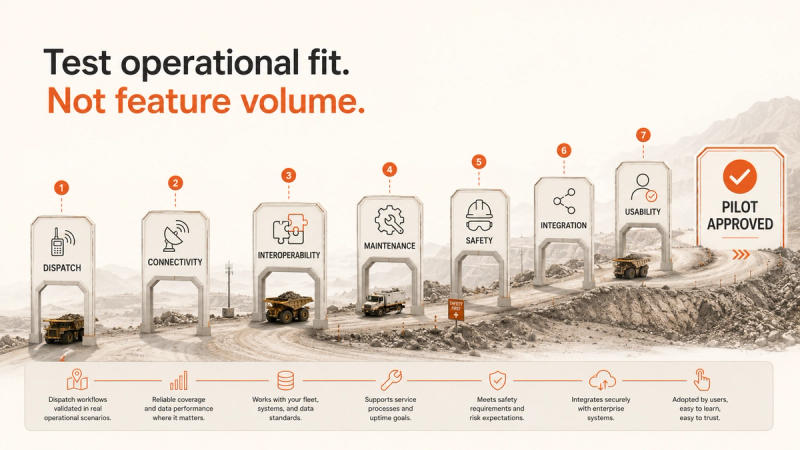
Seven Capabilities to Evaluate
1. Dispatch and Production Control
Test truck-to-shovel allocation, queue management, destination changes, delay capture, and material routing.
For underground operations, test task sequencing, heading priorities, equipment availability, and traffic restrictions.
Use the mine dispatch software evaluation checklist to convert these workflows into structured demonstration scenarios.
2. Connectivity Resilience
Ask what happens when equipment enters a low-coverage area.
The onboard application should preserve timestamps, store events locally, and synchronize them correctly after reconnection.
The interface should also distinguish a communication failure from an inactive asset. Otherwise, missing data may be incorrectly classified as an operational delay.
3. Mixed-Fleet Data Architecture
Require documentation showing how the platform converts J1939 CAN bus telemetry, proprietary OEM data, onboard devices, and API payloads into a consistent asset model.
SAE J1939 applies to heavy-duty and off-road equipment, but the data signals available can still vary by machine and manufacturer.
Test representative equipment from at least two OEMs. Confirm whether additional gateways, telematics devices, integrations, or licenses are required.
4. Maintenance and Asset Health
The mine fleet management system should exchange operating hours, fault data, delays, inspection findings, and maintenance release status with the CMMS or EAM.
Maintenance triggers should reflect approved site strategies, OEM requirements, equipment usage, and available condition data.
The mining equipment maintenance KPI guide can help define the performance and reliability measures that should be available.
5. Safety and Compliance
Inspection workflows should capture the asset, operator, timestamp, inspection results, identified defects, equipment restrictions, corrective action, and closure status.
In the United States, MSHA requires self-propelled mobile equipment to be inspected before being placed in operation during a shift. Safety defects that are not corrected immediately must be reported and recorded until they are resolved.
Other sites should configure workflows against applicable requirements, including DGMS legislation in India or Work Health and Safety mining requirements in Western Australia.
Photographs may strengthen the evidence trail, but they should not be presented as a universal legal requirement.
6. Integration and Data Ownership
Test complete workflows rather than accepting API documentation alone.
Verify whether a breakdown entered in the fleet platform creates the correct maintenance notification and whether equipment release status returns to dispatch.
The contract should define data ownership, export formats, retention, historical access, API availability, and offboarding requirements.
Read more about integrating fleet, ERP, and maintenance systems.
7. Frontline Usability
Ask dispatchers and supervisors to complete common shift activities during the demonstration.
These should include reassigning equipment, recording a delay, investigating a missed target, completing a shift handover, and reporting a defect.
A technically advanced platform can still fail when common actions require excessive screens, manual entries, or approvals.
Validate the Platform Through a Controlled Pilot
The pilot should include mixed equipment, a low-connectivity area, a complete production cycle, an equipment-status change, a safety workflow, and one live integration.
Agree on acceptance criteria before testing.
These may include:
- Synchronization completeness
- Data latency
- Asset visibility
- Cycle accuracy
- User adoption
- Time required to investigate an exception
The pilot should test the conditions most likely to create operational failure, not only the workflows that perform well during a vendor demonstration.
When Fleet Visibility Is Not Enough
A fleet management system may track mobile equipment effectively while production decisions remain fragmented across maintenance, workforce, planning, and ERP systems.
This is where mining operations intelligence becomes relevant.
AIM by HonestDig is designed as an intelligence and control layer that connects operational signals across existing systems rather than requiring mines to replace their current technology stack.
Frequently Asked Questions
What is mining fleet management software?
Mining fleet management software helps mines track equipment, manage dispatch, monitor cycle times, improve asset utilization, and coordinate production activity. A modern mine fleet management system may also connect with maintenance, safety, fuel, workforce, and ERP platforms.
How does open-pit fleet management software improve production?
Open-pit fleet management software supports truck-to-shovel allocation, queue management, payload monitoring, route optimization, and cycle-time analysis. It helps dispatch teams respond to changing equipment availability, road conditions, and production priorities during the shift.
What should buyers look for in underground mining fleet management software?
Underground mining fleet management software should support non-GPS positioning, 3D mine context, traffic coordination, equipment tracking, offline data capture, and underground communication networks. Buyers should also test how the platform performs in low-connectivity headings, declines, and production areas.
Can mining dispatch software support mixed-fleet operations?
Mining dispatch software can support mixed-fleet operations when it can collect and standardize data from different equipment manufacturers. Buyers should verify compatibility with OEM telemetry, J1939 CAN bus data, third-party tracking devices, and API integrations before selecting mixed-fleet mining software.
How should a mine evaluate mining fleet management software before purchase?
A mine should evaluate mining fleet management software through a controlled site pilot. The pilot should test dispatch, mixed-fleet data, low-connectivity performance, maintenance integration, safety workflows, cycle accuracy, and frontline usability under actual operating conditions.
Select Software for the Mine You Actually Operate
The right mining fleet management software should remain reliable when connectivity weakens, equipment brands differ, production priorities change, and frontline teams need to act quickly.
Select vendors using operational evidence. Then test the highest-risk conditions before committing to a site-wide rollout.
Talk to HonestDig about assessing how fleet, maintenance, workforce, and production systems can support a more unified operating model.