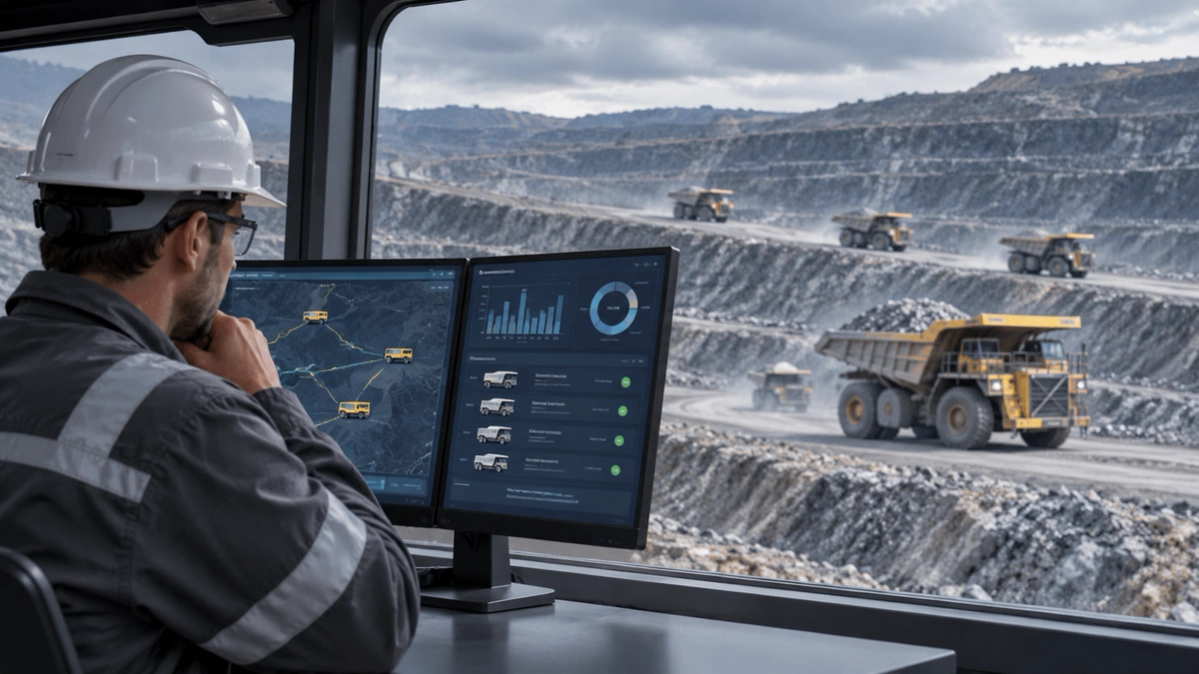
Consider an open-pit mine operating 30 haul trucks and four shovels. Several trucks queue at one loading point while another shovel remains underutilized. The control room can track their locations, yet production continues to fall behind schedule.
This highlights an important distinction: knowing where equipment is operating is not the same as optimizing how it performs.
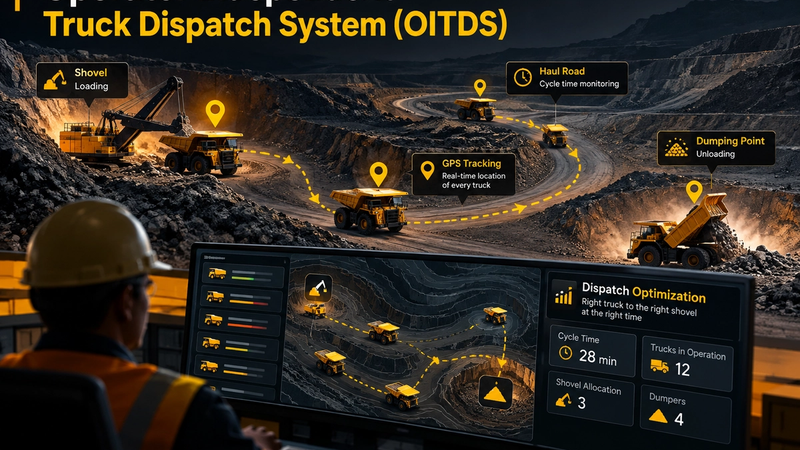
An Operator Independent Truck Dispatch System (OITDS) helps mines automate truck movement tracking, monitor haulage cycles, and improve dispatch coordination.
However, GPS visibility alone cannot resolve every production bottleneck. Understanding how OITDS works, its limitations, and how connected operational intelligence complements it is essential for modern mining operations.
Key Takeaway
An Operator Independent Truck Dispatch System uses GPS tracking, geofencing, and automated event detection to monitor haulage activities with reduced manual reporting. It improves fleet visibility and supports better dispatch decisions. However, sustainable production improvements depend on accurate operational data, effective truck allocation, and coordination across mining systems.
What Is an Operator Independent Truck Dispatch System (OITDS)?
An Operator Independent Truck Dispatch System is a mining fleet management technology designed to monitor truck movements and operational activities without relying entirely on manual operator inputs.
Traditional dispatch processes may require drivers to report loading, dumping, and delays through onboard devices or radio communication. OITDS automates selected activities using equipment locations and operational signals.
Three approaches should be distinguished:
- Operator-dependent dispatch: Drivers manually report operational events.
- OITDS: Equipment movements and haulage events are identified automatically.
- Autonomous haulage: Driverless trucks operate through automated vehicle control systems.
OITDS does not make trucks driverless. Its primary purpose is to improve operational data accuracy and reduce dependence on manual reporting.
This is particularly valuable for mines managing mixed equipment fleets, multiple contractors, and complex haulage operations.
How Does OITDS Work in Mining?
OITDS combines three core functions to support equipment monitoring and dispatch coordination.
1. GPS-Based Equipment Tracking
GPS devices installed on haul trucks and other heavy earth-moving machinery monitor equipment movement.
Geofences identify loading points, haul roads, crushers, stockpiles, and dumping locations. Dispatchers use this information to monitor equipment activity from a centralized system.
2. Automated Cycle Time Monitoring
OITDS identifies operational events to calculate haulage cycle times and detect delays.
Consider an illustrative 24-minute haulage cycle:
- Loading: 4 minutes
- Loaded travel: 7 minutes
- Dumping: 2 minutes
- Empty return: 5 minutes
- Queuing: 6 minutes
Queuing represents 25% of the total cycle. Reducing it from six to three minutes would shorten the cycle to 21 minutes, assuming other activities remain unchanged.
This demonstrates why understanding cycle components matters more than simply counting completed trips.
Learn more about how to calculate haul truck cycle time.
3. Truck Allocation and Dispatch Decisions
Dispatch software evaluates truck locations, shovel availability, queue lengths, and production priorities.
Some systems recommend truck assignments for dispatcher approval, while advanced configurations automatically adjust allocations.
Tracking identifies equipment movement. Dispatch optimization determines how equipment should be allocated.
OITDS Adoption in Indian Mines
India provides an important example of OITDS adoption, particularly across large opencast coal mining operations.
The Ministry of Coal documented OITDS implementation across multiple Coal India subsidiaries, including Northern Coalfields Limited, South Eastern Coalfields Limited, and Mahanadi Coalfields Limited.
A January 2024 Ministry presentation reported 137 heavy earth-moving machines equipped with OITDS across three Mahanadi Coalfields opencast projects: Balram, Lingaraj, and Bharatpur.
These deployments demonstrate the use of digital systems to improve equipment movement visibility and operational coordination.
Indian mining operations also highlight practical implementation challenges, including contractor-operated fleets, changing benches, monsoon conditions, deep pits, and inconsistent network connectivity.
Similar challenges affect coal, iron ore, limestone, and other surface mining operations globally.
Key Benefits and Performance Indicators of OITDS
An effective OITDS provides operational data that helps mining teams identify inefficiencies and improve equipment coordination.
Performance Indicator | Operational Value |
|---|---|
Truck cycle time | Identifies delays in loading, hauling, and dumping |
Queue time | Reveals congestion at loading and dumping locations |
Shovel utilization | Measures productive time against available time |
Haulage productivity | Tracks tonnes transported per operating hour |
Equipment idle time | Highlights avoidable equipment inactivity |
Dispatch response time | Measures the speed of allocation adjustments |
These indicators should be evaluated together.
For example, ten trips carrying 70 tonnes transport less material than nine trips carrying 90 tonnes. Higher trip counts do not necessarily mean better production performance.
Explore mining production KPIs to understand how equipment performance connects with production efficiency.
Common OITDS Implementation Challenges
Successful OITDS deployment requires more than installing tracking devices. Mining companies must address several operational challenges.
Changing mine layouts: Geofences need regular updates as benches, haul roads, and dumping locations change.
Connectivity interruptions: Offline data storage and synchronization help preserve records when communication networks become unreliable.
Mixed equipment fleets: Tracking devices and event-detection logic must be tested across different truck models and manufacturers.
Safety monitoring: Speed alerts, route-deviation monitoring, and restricted-area notifications support safer fleet operations. Dedicated collision avoidance systems remain necessary for proximity-related risks.
Disconnected operational systems: Integrating dispatch information with maintenance, processing, and production data provides a clearer picture of operational constraints.
During implementation, mines should validate event-detection accuracy, data latency, equipment compatibility, and system performance under actual site conditions.
Why OITDS Alone Cannot Optimize Mine Production
Consider six trucks waiting at a loading point.
An OITDS identifies excessive queuing and indicates that truck allocation needs attention.
However, connected maintenance and processing data reveal that the crusher is operating below capacity. This downstream restriction is slowing material movement and contributing to congestion.
Simply reallocating trucks may shift the problem to another location rather than eliminate it.
Resolving the issue requires a coordinated understanding of dispatch, equipment availability, and processing capacity.
This is where real-time operational intelligence in mining becomes valuable.
Instead of only showing where equipment is operating, connected intelligence helps mining teams identify why performance is declining and which corrective actions deserve priority.
AI can build on this information by analyzing historical cycles, equipment conditions, and production patterns to identify recurring delays and recommend operational adjustments.
Moving Beyond Truck Tracking With AIM by HonestDig
OITDS provides a foundation for digital fleet management, but mining productivity depends on how effectively equipment, maintenance, and production activities work together.
AIM by HonestDig connects operational data to support intelligent decision-making across mining activities.
Through its Guaranteed Production Throughput solution, HonestDig focuses on connecting fleet dispatch, equipment performance, maintenance coordination, and production priorities.
The objective is to move beyond monitoring individual assets toward understanding the performance of the entire mining operation.
Tracking tells mining teams what is happening. Connected operational intelligence helps them determine what should happen next.
Improve Mining Performance With AIM by HonestDig
Knowing where your trucks are is only the beginning.
Discover how AIM by HonestDig connects fleet, maintenance, and production intelligence to help mining teams identify bottlenecks, reduce avoidable delays, and improve operational decision-making.
Schedule a Demo or Contact HonestDig to explore how connected mining intelligence can support your operation.
Frequently Asked Questions
What is an Operator Independent Truck Dispatch System?
An Operator Independent Truck Dispatch System (OITDS) uses GPS tracking, geofencing, and automated event detection to monitor truck movements, record haulage activities, and support dispatch decisions without relying entirely on manual operator reporting.
How is OITDS used in mining?
OITDS is used to monitor haul truck movements, identify loading and dumping events, measure cycle times, and support equipment allocation across loading points and material destinations.
What is the difference between OITDS and GPS tracking?
GPS tracking primarily provides vehicle locations. OITDS extends location data through operational event identification, cycle time monitoring, and dispatch coordination.
Can OITDS reduce truck waiting time?
OITDS identifies where and when trucks experience delays. Effective dispatch decisions based on this information can reduce avoidable queuing and improve equipment utilization.
How does AI improve mining truck dispatch?
AI analyzes haulage cycles, equipment availability, delays, and production conditions to identify bottlenecks, anticipate disruptions, and recommend better operational decisions. Its effectiveness depends on reliable data and integration with mine systems.