Underground Loader-Truck Matching: Reduce Drawpoint Queues
Learn underground loader-truck matching using LHD pass count, cycle time, match factor, and dynamic dispatch to reduce queues and ore flow delays.
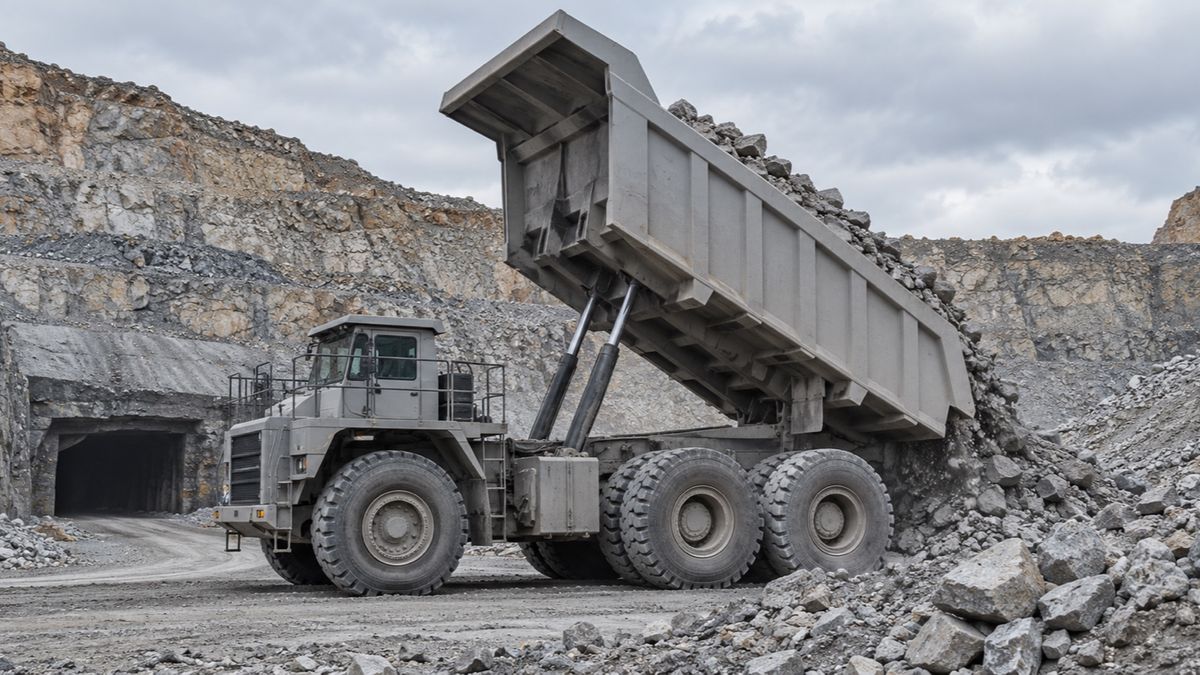
Underground Loader-Truck Matching: How to Reduce Drawpoint Queues and Ore Flow Delays
Underground loader-truck matching is not simply a question of how many trucks should be assigned to each LHD.
It is a capacity-balancing problem influenced by loading time, pass count, travel distance, haul ramp conditions, equipment availability, drawpoint access, ore-pass congestion, and traffic restrictions.
Adding trucks can improve ore flow until the underground network reaches its service limit. Beyond that point, vehicles begin waiting at drawpoints, intersections, passing bays, or tipping locations. The result is more idling and congestion without a proportional increase in tonnes moved.
Mapping the Haulage Loop for Underground Mine Fleet Optimization
Measure the complete haulage cycle before changing equipment allocation:
Truck cycle time = Loading + Loaded travel + Dumping + Empty return + Spotting + Traffic delays
Segment this data by stope, drawpoint, truck class, route, shift, and material type.
A single fleet average can hide an underperforming ramp, a congested ore pass, or repeated delays at one intersection. Use actual time distributions rather than relying only on planning assumptions.
Where underground location data is incomplete, review the requirements for real-time visibility in underground mining. Accurate loader and truck positions are essential for distinguishing genuine equipment inactivity from communication loss.
Calculate LHD Pass Count and Loading Time
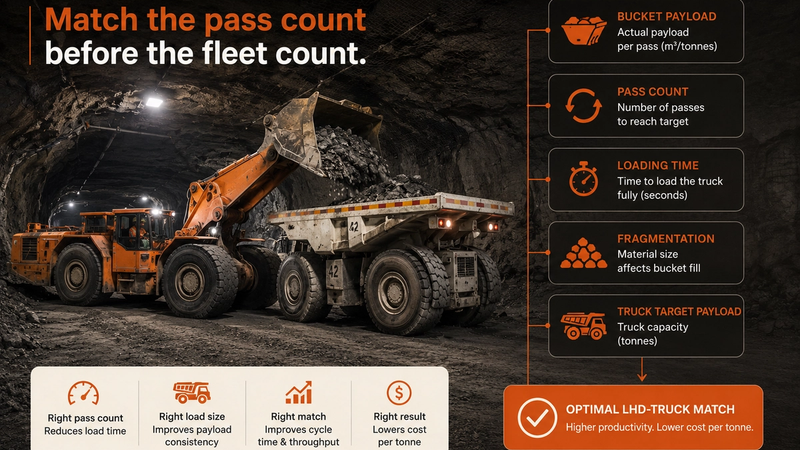
LHD pass count determines how long a truck occupies the loading position.
Passes per truck = Truck target payload ÷ Average tonnes per LHD bucket
Truck loading time = Passes per truck × Average LHD pass cycle + Positioning time
Average bucket payload should reflect measured fill factor, fragmentation, material density, carryback, and drawpoint condition. Nominal bucket capacity alone is not enough.
There is no universal pass-count target for every underground fleet. The correct LHD truck matching arrangement should safely achieve the truck’s target payload with consistent bucket fill and acceptable loading time.
If pass count rises unexpectedly, investigate:
- Oversized or poorly fragmented material
- Reduced bucket fill factor
- Drawpoint hang-ups
- Carryback inside the truck body
- Poor truck positioning
- Changes in material density
Do not assume the LHD is undersized until these conditions have been checked.
Calculating the Underground Loader-Truck Match Factor
For one loader class serving one truck class:
Match Factor = (Number of trucks × Loading time per truck) ÷ (Number of loaders × Truck cycle time)
The theoretical balanced fleet is:
Balanced trucks = Number of loaders × Truck cycle time ÷ Loading time
Consider one LHD with a six-minute loading time and trucks completing a 30-minute cycle.
Trucks | Loading Time | Cycle Time | Match Factor | Expected Condition |
|---|---|---|---|---|
4 | 6 minutes | 30 minutes | 0.80 | Loader waiting risk |
5 | 6 minutes | 30 minutes | 1.00 | Theoretical balance |
6 | 6 minutes | 30 minutes | 1.20 | Drawpoint queue risk |
A match factor below 1.0 means truck arrival capacity is lower than loader service capacity. The LHD may wait for trucks.
A value above 1.0 means trucks can arrive faster than the loader can serve them. This increases the risk of underground congestion.
The formula provides a starting point, not a complete operating answer. Single-lane drives, passing-bay availability, intersections, variable ramp speeds, and ore-pass capacity can still create queues when the average match factor appears balanced.
Drawpoint Queue Reduction: Diagnose the Bottleneck Location
The location of a queue often reveals its root cause.
Trucks waiting at a drawpoint may indicate excessive truck allocation, high pass counts, poor fragmentation, or slow loading.
Queues at intersections or passing bays usually point to traffic-control constraints, route conflicts, or poor equipment sequencing.
Loaded trucks waiting near an ore pass indicate that the downstream tipping or material-handling system is restricting ore flow.
An idle LHD with no truck available may indicate under-allocation, inaccurate travel-time assumptions, or ineffective dispatch timing.
This distinction matters because reducing trucks at a drawpoint will not solve an ore-pass bottleneck. Drawpoint queue reduction must address the actual location where service capacity is being exceeded.
Use haul truck cycle-time analysis to separate loading, travel, dumping, spotting, and waiting losses.
Use Dynamic Underground Truck Dispatch
Static allocation assigns a fixed number of trucks to each loader for an entire shift. This arrangement becomes inefficient as conditions change.
Dynamic underground truck dispatch should consider:
- Stope and drawpoint priority
- Loader availability
- Current queue depth
- Estimated travel time
- Ore-pass availability
- Traffic restrictions
- Payload and material destination
- Battery or fuel status where applicable
The objective is controlled ore flow, not equal truck distribution.
A high-priority drawpoint may temporarily receive additional trucks while another circuit is reduced to prevent congestion. Dispatch decisions should respond to live operating conditions rather than preserving fixed allocations that no longer reflect the mine.
Validate Underground Haulage Optimization Against the Shift
Track loader idle time, truck waiting time, maximum queue depth, LHD pass count, bucket payload, travel-time percentiles, ore-pass delay, equipment availability, and tonnes moved by drawpoint.
Review payload distribution and cycle-time variation, not only shift averages.
Where operating variability is high, Discrete-Event Simulation, or DES, can test different fleet sizes, route rules, passing-bay configurations, breakdown scenarios, and traffic controls before changes are implemented.
Maintenance information should also be included. The mining equipment maintenance KPI guide can help teams determine whether repeated delays originate from equipment reliability rather than allocation logic.
Connect Matching Decisions to Live Operational Control
The formulas establish the expected loader-truck balance. Maintaining that balance requires live information about truck locations, loader status, queues, routes, and production priorities.
AIM by HonestDig bridges this visibility gap by connecting fleet telemetry, cycle performance, equipment readiness, and operational priorities in one control layer. Dispatchers can identify emerging bottlenecks before queues compound across the underground network.
This supports predictive site resilience while helping underground teams respond to actual shift conditions.
Frequently Asked Questions
What is underground loader-truck matching?
Underground loader-truck matching balances LHD loading capacity with truck cycle capacity so loaders are not starved and trucks do not create excessive drawpoint queues.
How do you calculate the number of trucks required per LHD?
Divide total truck cycle time by loading time per truck, then test the result against equipment availability, traffic constraints, and cycle-time variability.
How does LHD pass count affect underground haulage optimization?
Higher LHD pass count increases truck loading time and reduces loader service capacity. Pass count should be based on measured bucket payload and the truck’s target payload.
What causes drawpoint queues in underground mines?
Drawpoint queues can result from excessive truck allocation, high pass counts, poor fragmentation, slow positioning, traffic conflicts, ore-pass delays, or static dispatch rules.
Can dynamic underground truck dispatch reduce ore flow delays?
Yes. Dynamic underground truck dispatch can route trucks using live loader status, queue depth, stope priority, travel time, and ore-pass availability.
Find the Constraint Before Adding Another Truck
Effective underground loader-truck matching starts with measured pass count, loading time, travel variability, queue location, and downstream capacity.
Do not add trucks based only on a fleet average or planning model. Identify where the delay begins, then adjust the fleet, route, or dispatch rule against the constraint that is actually limiting ore flow.
Request an underground flow walkthrough to see how AIM connects loaders, trucks, drawpoints, and production priorities through one live operating view.