Why Most Mining AI Projects Fail Before Reaching Production
Learn why most mining AI projects fail before reaching production and what mining companies need to scale AI beyond pilots into real operational value.
Why the Problem Is Not AI, but the Gap Between Pilot and Production
Mining companies are investing heavily in AI, automation, and advanced analytics. The market momentum is real, but the operational results are far less impressive. Across industries, most AI projects still fail to scale, and mining is one of the clearest examples of this pilot-to-production gap. Research consistently shows that the majority of AI initiatives stall before they create enterprise-wide value, with many never moving beyond proof-of-concept environments at all.
The reason is usually not that the model does not work.
It is that the model only works under pilot conditions.
In a pilot, data is cleaner, workflows are controlled, expectations are narrower, and success is easier to demonstrate. Production is different. Production means live operations, messy inputs, cross-functional dependencies, frontline adoption, uptime expectations, and direct impact on throughput, maintenance, safety, and cost.
That is where most mining AI projects start to fail.
What Pilot Success Looks Like and Why It Can Be Misleading
A pilot often proves that an AI model can identify a pattern, generate a recommendation, or predict an outcome under controlled conditions.
That sounds valuable, but controlled conditions are not enough.
Mining operations deal with variables that change constantly, including ore characteristics, equipment behavior, operator practices, weather conditions, and site constraints. A model trained on historical or manually cleaned data may look strong in testing but fail once it has to handle missing fields, delayed signals, or inconsistent inputs from real operations. Bain notes this is a common reason AI initiatives stumble, especially when pilots rely on offline data preparation that cannot be sustained at scale.
This is why many pilots look impressive in review meetings but create little value on site.
They prove the concept, not the operating reality.
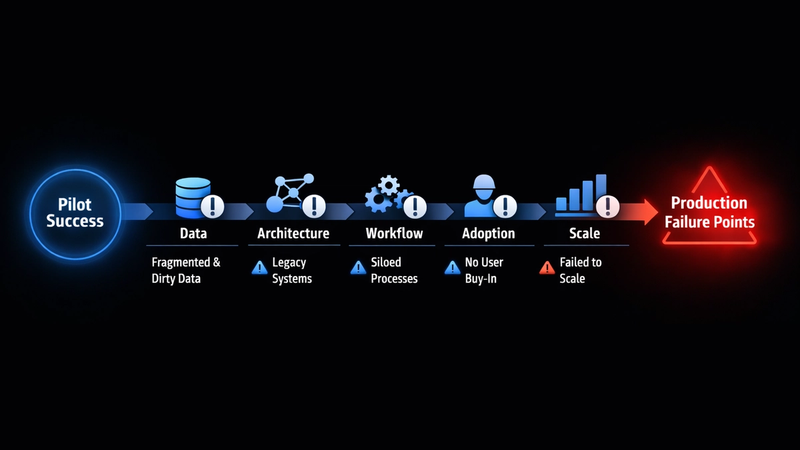
The Five Reasons Most Mining AI Projects Fail Before Production
1. Weak Data Foundations
Most mining AI projects are built on fragmented data environments.
Exploration, maintenance, production, workforce, and compliance data often live in separate systems. Time stamps may not align. Data quality varies across sites. Important metadata is missing. When that happens, the model may still work in a test environment, but it becomes unreliable in production.
This is closely related to the challenge discussed in why ERP systems alone cannot optimize modern mining operations, where systems collect information but do not create a unified operational view.
2. No Production-Ready Architecture
A mining AI pilot can run on a laptop, in a sandbox, or on a limited cloud setup.
Production cannot.
Once the model has to process live data continuously, costs increase, latency matters, sensor reliability matters, and infrastructure becomes critical. McKinsey’s work with Freeport-McMoRan shows that scalable AI in mining depends heavily on having a central digital architecture and modular deployment model from the start, not after the pilot succeeds.
3. No Workflow Redesign
This is one of the biggest reasons projects fail.
AI is often added on top of existing workflows instead of changing how decisions are made. Broader AI research shows that workflow redesign is one of the strongest predictors of enterprise value, yet many organizations still treat AI as a side tool rather than as part of the operating model.
If operators, planners, dispatchers, or maintenance teams do not use the output inside daily routines, the model becomes just another dashboard.
4. Low Frontline Trust and Adoption
Even a technically sound model will stall if the people using it do not trust it.
Mining is a high-stakes environment. Teams are unlikely to rely on AI output if they do not understand where the recommendation came from, how accurate it is, or what happens when conditions change. Recent mining research also points to the need for ongoing workforce education as digital systems become more embedded in operations.
5. No Clear Ownership of Value
A surprising number of AI projects start with no firm agreement on what success actually means.
If there is no defined target such as reduced downtime, improved utilization, faster cycle decisions, or lower maintenance leakage, then the project becomes hard to defend once scaling costs rise. That is when pilots get abandoned.
Why Mining Production Is Harder Than Most AI Teams Expect
Mining environments are not clean digital labs.
They are harsh, variable, and physically demanding. Sensors degrade. Connectivity drops. Equipment conditions change. Data arrives incomplete. Operational priorities shift between safety, production, and maintenance. This is one reason mining-specific predictive maintenance research keeps highlighting interoperability issues, inconsistent data formats, weak standardization, and lack of real-world validation as major barriers to deployment.
This is also where the link between AI and operational systems becomes critical.
A model that improves dispatch logic but is disconnected from actual field conditions will not deliver value. A predictive tool that identifies risk but does not integrate with response workflows will be ignored. A production AI system has to survive contact with reality.
That is why real-time operational intelligence in mining matters so much. AI does not scale well in a fragmented environment. It scales when it is part of a connected system.
What Successful Mining AI Deployments Do Differently
The projects that scale usually share a few traits.
They do not begin with the model alone. They begin with the operating problem.
They also tend to:
- target a clear bottleneck tied to financial or operational value
- use architecture that can handle live, cross-site data
- redesign workflows around decisions, not just insights
- involve operations teams early, not only data teams
- define success in measurable business terms
This is why AI initiatives that connect directly to guaranteed production throughput or predictive site resilience are more likely to matter. They are tied to actual operating outcomes, not just technical performance.
The Real Shift: From AI Project to Operating Model
Most mining AI projects fail before production because they are treated like experiments.
The ones that succeed are treated like operating-system changes.
That means the question is no longer, “Can the model work?”
The better question is, “Can the operation use this every day under real conditions?”
When mining companies solve for data reliability, workflow integration, frontline trust, and production architecture, AI starts to move beyond pilots and into real value. That is where it can support improvements already connected to AI-driven dispatch improving mining throughput, stronger resilience, and more stable operational control.
For companies still stuck in pilot mode, the next step is not another demo. It is building the environment where AI can survive production.
Frequently Asked Questions
1. Why do most mining AI projects fail after the pilot stage?
Because pilots run in controlled environments, while production requires handling messy data, real-time operations, and workflow integration. Most systems are not built for that transition.
2. What is the biggest mistake mining companies make with AI projects?
Treating AI as a standalone tool instead of integrating it into daily operational workflows and decision-making processes.
3. How important is data quality for scaling AI in mining?
Critical. Fragmented, inconsistent, or delayed data is one of the primary reasons models fail in production environments.
4. Why is frontline adoption important for AI success?
If operators and site teams do not trust or use the system, even accurate models will not create real impact on operations.
5. What separates successful mining AI deployments from failed ones?
Successful deployments focus on real operational problems, integrate with workflows, use scalable architecture, and define clear business outcomes from the start.