Cloud-Native vs Legacy Fleet Management Software in Mining
Compare cloud-native and legacy fleet management software in mining. Learn how real-time systems improve dispatch, visibility, and operational efficiency.
Why Fleet Management Software is Becoming the Core of Mining Operations
Mining operations today are not struggling because of lack of equipment.
They are struggling because their systems cannot support real-time decisions.
Fleet Management Software (FMS) has always been central to mining operations. It controls dispatch, monitors haulage, and tracks production. But its role has changed.
It is no longer just a tracking system.
It is becoming the operational backbone that determines how efficiently a mine runs.
As operations become more complex, the gap between legacy systems and cloud-native platforms is becoming more visible. And that gap directly impacts productivity, cost, and decision-making.
Understanding Legacy Fleet Management Systems in Mining Operations
Legacy fleet management systems were designed for stability, not speed.
They typically follow a monolithic architecture where:
- All components are tightly connected
- Updates require full system changes
- Data processing is delayed
These systems were effective when operations were simpler and decision cycles were slower.
But today, they create limitations:
- Data is fragmented across systems
- Visibility is delayed
- Decisions rely on manual interpretation
This is similar to what we discussed in why ERP systems alone cannot optimize modern mining operations.
Legacy systems answer one question well:
“What happened?”
They struggle with the more important one:
“What should we do right now?”
Cloud-Native Fleet Management Software in Mining: A Structural Shift
Cloud-native fleet management software represents a structural shift in how mining systems are built and operate. Unlike traditional setups, these systems are designed for real-time data processing, allowing information to be captured and acted upon instantly.
They bring together data from across operations into a unified view, making it easier for teams to stay aligned. At the same time, they support scalable operations and continuous updates without disrupting workflows.
Instead of collecting data and reporting it later, cloud-native platforms process information as it happens. This enables mining operations to move from reactive decision-making to proactive control.
Legacy vs Cloud-Native Fleet Management Systems: Key Differences That Impact Operations
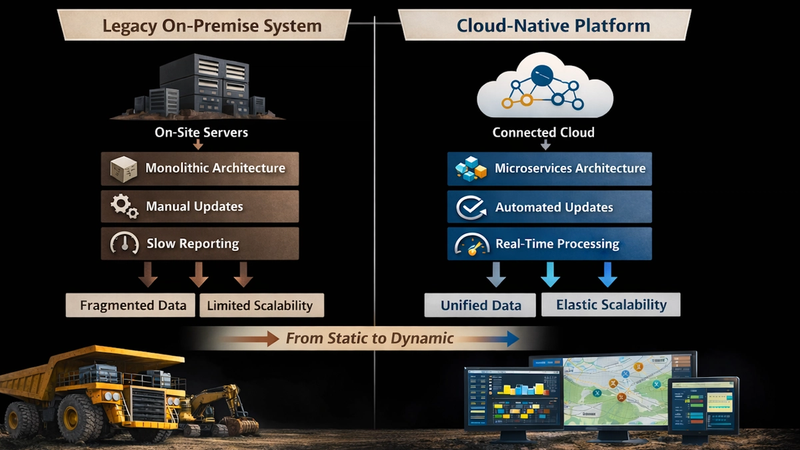
Legacy and cloud-native fleet management systems differ significantly in how they handle visibility and reporting. Legacy systems typically rely on batch-based data processing, where information is collected and analyzed after operations have already taken place. This often results in multiple disconnected dashboards and limited real-time visibility, making it harder for teams to respond quickly to changing conditions.
Cloud-native systems, on the other hand, are built around real-time data and unified operations. Instead of delayed reporting, they provide instant access to performance insights through a single operational view, enabling faster and more accurate decision-making.
Aspect | Legacy Systems | Cloud-Native Systems |
|---|---|---|
Data Processing | Batch-based processing | Live data streams |
Visibility | Limited real-time visibility | Instant performance visibility |
System View | Multiple dashboards | Single unified operational view |
Decision Support | Delayed insights | Real-time decision-making |
This shift from delayed reporting to real-time visibility directly strengthens operational intelligence in mining, allowing teams to act as situations develop rather than reacting after the impact.
This directly connects to real-time operational intelligence in mining.
Decision Speed and Dispatch Optimization
Decision speed is one of the biggest differences between legacy and cloud-native fleet management systems. Legacy systems typically support decisions after events have already occurred, which limits the ability to respond in real time. In contrast, cloud-native systems enable decisions during operations, allowing teams to act as situations develop.
For example, operations can instantly identify idle trucks, adjust dispatch in real time, and respond to bottlenecks as they emerge. This shift from reactive to real-time decision-making plays a key role in improving mining throughput, especially when supported by AI-driven dispatch systems.
This builds on AI-driven dispatch improving mining throughput.
Integration Across Mining Systems and Data Flow
Legacy systems are often difficult to integrate, leading to complex setups, data silos, and limited visibility across teams. This fragmentation makes it harder for different functions to operate with a shared understanding of the system.
In contrast, cloud-native systems are built with an API-first architecture, enabling seamless integrations and unified operational data. This allows teams across the operation to work from a single source of truth, eliminating fragmented decision-making.
Scalability and Deployment in Mining Environments
Legacy systems are typically hardware-dependent, slow to scale, and require high maintenance. Expanding these systems across sites can be time-consuming and resource-intensive.
Cloud-native systems, on the other hand, support elastic scaling, faster deployment, and a lower infrastructure burden. This makes them better suited for multi-site operations where flexibility and speed are critical.
Why Legacy Fleet Management Systems Create Operational Bottlenecks
Modern mining operations are becoming increasingly complex, with workforce shortages, rising costs, and a growing need for faster decision-making. In this environment, delays in identifying and responding to issues can lead to significant losses, as seen in the hidden costs of reactive maintenance in mining.
Legacy systems introduce a delay between event, data, insight, and decision. This gap slows down operations and limits responsiveness. Cloud-native systems significantly reduce this delay, allowing teams to move closer to real-time control.
As explained in the hidden costs of reactive maintenance in mining, delays in identifying issues lead to significant losses.
The Role of Edge + Cloud in Modern Mining Fleet Management
Connectivity has always been a concern in mining.
Cloud-native systems solve this through edge computing:
- Critical decisions happen locally
- Data syncs with the cloud
- Operations continue even during connectivity issues
This ensures uninterrupted decision-making.
Operational Impact: Where Cloud-Native Systems Deliver Value
Cloud-native systems deliver measurable improvements across operations. They improve dispatch efficiency by reducing idle time and enabling better cycle management. Predictive maintenance becomes more effective through early issue detection, helping prevent unexpected failures.
Workforce coordination also improves, as teams operate with better alignment and shared visibility. At the same time, production becomes more consistent, with reduced variability across shifts, leading to more predictable outcomes.
These outcomes align with guaranteed production throughput and predictive site resilience.
From Tracking to Control: The Future of Fleet Management in Mining
Fleet management in mining is evolving from a system that tracks operations to one that actively controls them in real time. Earlier, the focus was on visibility, understanding what had already happened across the operation. Today, the expectation has shifted toward control, where decisions are made as events unfold.
Legacy systems continue to provide visibility into operations, but cloud-native systems go a step further by enabling real-time control. This shift from tracking to control is defining the future of mining operations, where speed, responsiveness, and precision play a critical role in overall performance.
Choosing the Right Fleet Management System
The choice between legacy and cloud-native systems impacts:
- Decision speed
- Resource efficiency
- Production predictability
As mining operations become more data-driven, systems that cannot operate in real time will continue to limit performance.
If your operations are still relying on delayed reporting, it is time to rethink your system. Connect with AIM by HonestDig
Explore how guaranteed production throughput and autonomous workforce governance can help you move toward real-time operational control.
Frequently Asked Questions
1. What is cloud-native fleet management software in mining?
It is a modern system that processes data in real time and supports faster operational decisions.
2. Why are legacy fleet systems still used?
They are deeply embedded in operations and require structured transitions to replace.
3. How does cloud-native software improve mining efficiency?
It enables faster decisions, better visibility, and reduced downtime.
4. Can cloud-native systems work in remote mining sites?
Yes. Edge computing ensures operations continue even with limited connectivity.
5. Is migration from legacy to cloud-native difficult?
It requires planning, but phased implementation allows gradual transition without disruption.