Mining Fleet Management Software Pricing and ROI With Calculator
Understand mining fleet management software pricing and calculate three-year ROI and payback using a practical mine fleet example.
Mining Fleet Management Software Pricing and ROI With Calculator
Understand what mining fleet software costs and use a practical calculator to estimate potential ROI and payback.
A mine receives three proposals for fleet management software. One vendor charges by equipment unit. Another offers a site licence. The third combines software, onboard hardware and annual support.
The lowest licence fee initially looks like the best option.
Once installation, integration, training and support are included, it becomes the most expensive proposal over three years.
This is why mining fleet management software pricing should never be compared using the licence fee alone. The real question is whether the platform can recover enough value from fuel, production, downtime and administrative losses to justify its total cost.
Key Takeaway
Mining fleet management software usually uses custom pricing based on fleet size, required features, hardware and integrations. Buyers should compare the three-year total cost and calculate ROI using their own operational data. A lower software price does not always mean a lower overall cost.
How Much Does Mining Fleet Management Software Cost?
Most major mining platforms do not publish fixed prices.
Cat MineStar Fleet, Komatsu DISPATCH and Hexagon OP Pro provide prices based on the requirements of each mine.
The final cost normally depends on:
- Number and type of equipment
- Required software features
- Onboard devices and installation
- Site connectivity
- Integration with existing systems
- Training and ongoing support
A mine that already has compatible equipment and reliable connectivity will have a different cost from a mine that requires new hardware and network infrastructure.
What Should Be Included in the Cost?
Buyers should calculate total cost of ownership rather than looking only at the annual software fee.
Cost area | What it includes |
|---|---|
Software | Licences, modules and user access |
Hardware | Onboard devices, displays and sensors |
Implementation | Configuration, installation and testing |
Integration | Connections with ERP, maintenance, fuel and planning systems |
Training | Training for dispatchers, supervisors and operators |
Ongoing costs | Support, hosting, connectivity and internal administration |
A useful three-year formula is:
Three-Year TCO = Initial Costs + Three Years of Recurring Costs
The initial costs include implementation, hardware and integration. Recurring costs include licences, hosting, connectivity and support.
Mining Fleet Management ROI Calculator
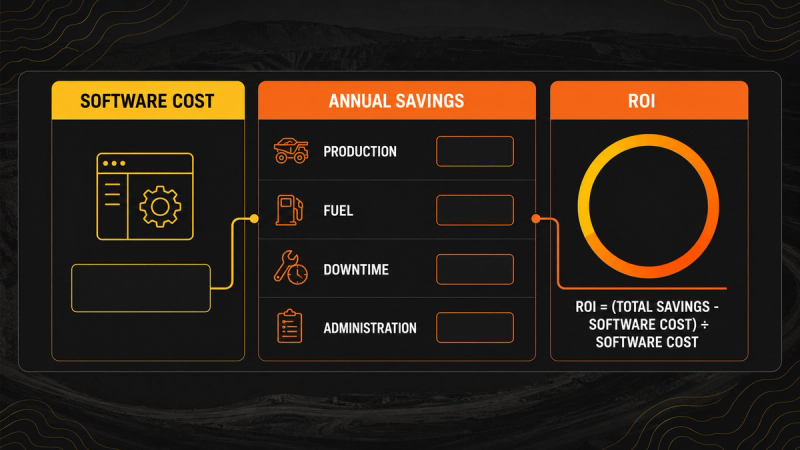
Fleet management ROI normally comes from four areas:
Benefit area | Simple calculation |
|---|---|
Additional production | Extra tonnes × contribution margin per tonne |
Fuel savings | Annual fuel cost × expected reduction |
Downtime savings | Avoidable downtime cost × expected reduction |
Administrative savings | Hours saved × labour cost per hour |
Use these formulas:
Annual Benefit = Production + Fuel + Downtime + Administrative Savings
Three-Year ROI = ((Three-Year Benefit − Three-Year TCO) ÷ Three-Year TCO) × 100
Payback Period = Initial Investment ÷ Annual Net Benefit × 12
Worked Mining Fleet ROI Example
Consider a surface mine with 35 haul trucks moving 12 million tonnes annually.
These figures are examples only. Every mine should replace them with its own verified production and cost data.
Estimated Annual Benefits
Input | Assumption | Annual benefit |
|---|---|---|
Additional production | 1% improvement or 120,000 tonnes at $2.50 contribution margin | $300,000 |
Fuel savings | 2% of $10 million annual fuel cost | $200,000 |
Downtime savings | 5% of $3 million avoidable downtime cost | $150,000 |
Administrative savings | 1,200 hours saved at $45 per hour | $54,000 |
Total annual benefit | $704,000 |
Contribution margin can differ significantly by commodity, mine plan and operating cost. Use a figure approved by the mine’s finance team.
Estimated Software Costs
Cost | Amount |
|---|---|
Software and implementation | $350,000 |
Hardware and integration | $200,000 |
Annual licence and support | $180,000 |
Initial investment | $550,000 |
Three-year TCO | $1,090,000 |
Calculated Return
Three-Year Benefit: $704,000 × 3 = $2,112,000
Three-Year ROI: (($2,112,000 − $1,090,000) ÷ $1,090,000) × 100 = 93.8%
Annual Net Benefit: $704,000 − $180,000 = $524,000
Estimated Payback: $550,000 ÷ $524,000 × 12 = 12.6 months
In this example, the investment pays for itself in just over one year.
Avoid Inflating the ROI
The biggest mistake is counting the same benefit twice.
If reduced downtime produces more tonnes, do not count the full value under both production and downtime. If lower idling reduces fuel consumption, make sure that saving is not already included in another efficiency calculation.
Use contribution margin rather than total revenue when valuing additional tonnes. This produces a more realistic estimate of the financial benefit.
The final business case should include conservative, expected and higher-return scenarios. If the investment works only under the most optimistic assumptions, the projected ROI is too weak.
Use Real Mine Data
The calculator should use recent site data for:
- Tonnes moved
- Fuel consumption
- Equipment utilisation
- Queue and idle time
- Unplanned downtime
- Reporting hours
Guides on reducing haul truck idle time, payload optimisation and maintenance KPIs can help establish these baselines.
Do not use a vendor’s highest reported improvement as the forecast for your mine. Vendor results show what may be possible, but the business case must reflect the conditions of the specific site.
Where AIM by HonestDig Fits
AIM by HonestDig connects fleet, workforce and operational information in one platform.
Its ROI can come from reduced idle time, faster responses to production delays, better equipment coordination and less manual reporting. Pricing depends on the mine’s systems, integrations and operational requirements.
For a broader investment framework, read the guide to building a mining software ROI business case.
Compare Value, Not Only Price
The cheapest fleet management platform is not always the one with the lowest licence fee.
Compare every vendor using the same cost and ROI model. Ask them to state every implementation cost and explain how the software will produce the expected operational improvement.
The right platform should deliver a measurable return without hiding costs or depending on unrealistic assumptions.
Frequently Asked Questions
How much does mining fleet management software cost?
Most enterprise mining platforms use custom pricing based on fleet size, features, hardware, integration and support requirements.
What should be included in the total cost?
Include software, hardware, implementation, integration, training, connectivity, support and internal administration.
How is fleet management software ROI calculated?
Subtract the three-year total cost from the three-year financial benefit, divide the result by the total cost and multiply by 100.
What is a good payback period?
It depends on the mine’s investment requirements. Compare the calculated payback with the company’s existing approval threshold.
Should additional tonnes be valued using revenue?
No. Use the contribution margin per additional tonne to avoid overstating the financial return.
Can fuel and downtime savings both be counted?
Yes, but only when they represent separate benefits. Remove any overlap with throughput or cost-per-tonne improvements.