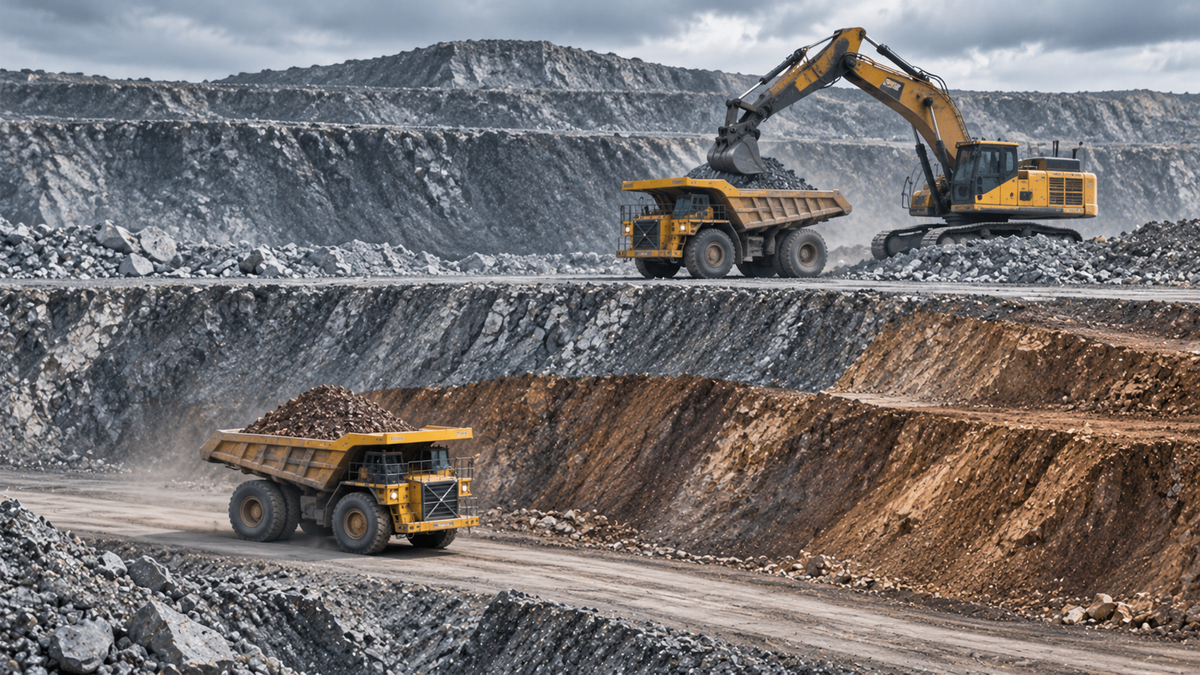
An open-pit mine plans to remove 600,000 tonnes of waste and produce 200,000 tonnes of ore. Its planned stripping ratio is 3:1.
At month-end, the ratio reaches 4:1.
Did the mine remove too much waste, or did ore production fall behind?
Both situations produce the same ratio but require different corrective actions.
Stripping ratio in open-pit mining connects waste movement, ore production, and mining economics. Understanding what drives changes in this ratio is essential for controlling costs and maintaining production performance.
Key Takeaway
A higher stripping ratio does not always mean excessive waste removal. It can also result from lower ore production. The important distinction is identifying which activity caused the deviation, whether it was planned, and how it affects cost per tonne of ore.
What Is Stripping Ratio in Open-Pit Mining?
Stripping ratio, also called the waste-to-ore ratio, measures the quantity of waste removed relative to ore extracted.
Stripping Ratio = Waste Removed ÷ Ore Mined
A 3:1 stripping ratio means three tonnes of waste are removed for every tonne of ore produced.
Ratios may be expressed in tonnes per tonne (t/t) or cubic metres per tonne (m³/t).
Indian opencast coal operations commonly report overburden removal in cubic metres against coal production in tonnes.
These measurement bases are not interchangeable without accounting for waste density.
For example, 3 m³ of waste per tonne of ore at a waste density of 2 tonnes/m³ equals 6 tonnes of waste per tonne of ore.
Stripping Ratio Calculator: One Mine, Two Different Problems
Consider a hypothetical mine with a planned monthly stripping ratio of 3:1.
Scenario | Waste Removed | Ore Mined | Stripping Ratio |
|---|---|---|---|
Planned | 600,000 t | 200,000 t | 3:1 |
A: Additional waste | 800,000 t | 200,000 t | 4:1 |
B: Ore shortfall | 600,000 t | 150,000 t | 4:1 |
Both scenarios report a 4:1 ratio.
Scenario A: Waste movement increases by 200,000 tonnes. At an illustrative $2.50 per tonne, additional waste removal costs $500,000.
Scenario B: Waste movement remains unchanged, but ore production falls by 50,000 tonnes. The problem is an ore production shortfall, potentially affecting sales and production targets.
The same reported stripping ratio therefore reveals two completely different operational situations.
This is why mines must analyze waste and ore performance separately rather than relying on the ratio alone.
How Stripping Ratio Affects Mining Costs
Waste removal involves drilling, blasting, loading, hauling, fuel, and equipment maintenance.
A simplified relationship is:
Waste Cost per Tonne of Ore = Stripping Ratio × Waste Mining Cost per Tonne
At $2.50 per tonne of waste, the planned 3:1 ratio produces $7.50 in waste removal costs per tonne of ore.
At 4:1, this increases to $10.
However, waste mining costs rarely remain constant as pits deepen.
Longer haul distances, steeper ramps, and deteriorating road conditions increase fuel consumption, tyre stress, and truck cycle times.
For example, if waste movement costs increase from $2.50 to $3 per tonne, the same 4:1 stripping ratio costs $12 rather than $10 per tonne of ore.
This makes cost per tonne of waste moved an important measure alongside stripping ratio.
Explore haul truck cycle time, mining fuel cost reduction, and haul road rolling resistance.
What Is the Break-Even Stripping Ratio?
The break-even stripping ratio estimates the maximum waste removal economically supported by the recoverable value of ore under defined assumptions.
Break-Even Stripping Ratio = (Recoverable Revenue − Non-Stripping Costs) ÷ Waste Removal Cost
Using our hypothetical mine:
- Recoverable revenue: $45 per tonne of ore
- Non-stripping costs: $30 per tonne of ore
- Waste removal cost: $2.50 per tonne
Break-Even Stripping Ratio = (45 − 30) ÷ 2.50 = 6:1
The actual 4:1 ratio remains two tonnes of waste per tonne of ore below this illustrative break-even threshold, equivalent to $5 per tonne of ore in remaining margin before other excluded costs.
The 6:1 result is an assumption-driven illustration, not a typical industry benchmark.
Non-stripping costs include ore mining, transportation, processing, and applicable overheads.
Break-even stripping ratio is primarily an economic planning input for pit limits, not a daily operating target.
It also differs from cutoff grade, which determines whether mineralized material meets the economic criteria for classification and processing as ore.
Why Ore and Waste Classification Matters
Incorrect material classification can distort stripping ratio reporting.
Suppose 10,000 tonnes are incorrectly recorded as waste instead of ore within the planned monthly volumes.
Reported waste becomes 610,000 tonnes, while ore falls to 190,000 tonnes.
The reported stripping ratio becomes approximately 3.21:1 instead of 3:1.
Accurate grade control, dispatch coding, payload records, and production reconciliation are therefore essential.
Read more about planned vs actual mine production.
Connecting Stripping Ratio With Operational Intelligence
Return to the mine reporting 4:1 against a planned 3:1.
If waste production exceeded plan, supervisors should examine pre-stripping requirements, truck allocation, and waste haulage performance.
If ore production fell, they should investigate ore shovel availability, access restrictions, equipment delays, and grade-control decisions.
Dispatch allocation between ore and waste can change the reported ratio during a shift, making production coordination important.
AIM by HonestDig focuses on connecting fleet, equipment, maintenance, and production information to support better operational decisions.
Its Guaranteed Production Throughput solution addresses the wider challenge of maintaining production performance across interconnected mining activities.
The goal is not simply achieving a lower stripping ratio. It is keeping waste movement, ore production, and associated costs aligned with the mine plan.
Improve Mining Production Visibility With HonestDig
Understanding stripping ratio is only the starting point. Mining teams also need visibility into the operational factors driving production and cost deviations.
AIM by HonestDig supports connected operational intelligence for better equipment coordination and production decisions.
Schedule a Demo or Contact HonestDig to explore how connected mining intelligence can support your operations.
Frequently Asked Questions
What is stripping ratio in open-pit mining?
Stripping ratio measures waste removed relative to ore extracted. A 3:1 ratio means three tonnes of waste are removed for each tonne of ore.
How do you calculate stripping ratio?
Divide waste removed by ore mined, using a consistent measurement basis and reporting period.
What is a good stripping ratio?
There is no universal ideal ratio. Economic viability depends on ore value, mining costs, pit design, and production sequencing.
What is the break-even stripping ratio?
It is the maximum economically supportable waste removal per unit of ore under defined revenue and cost assumptions.
Why does stripping ratio increase?
It can increase because of additional waste removal, reduced ore production, pit development requirements, or inaccurate material classification.